
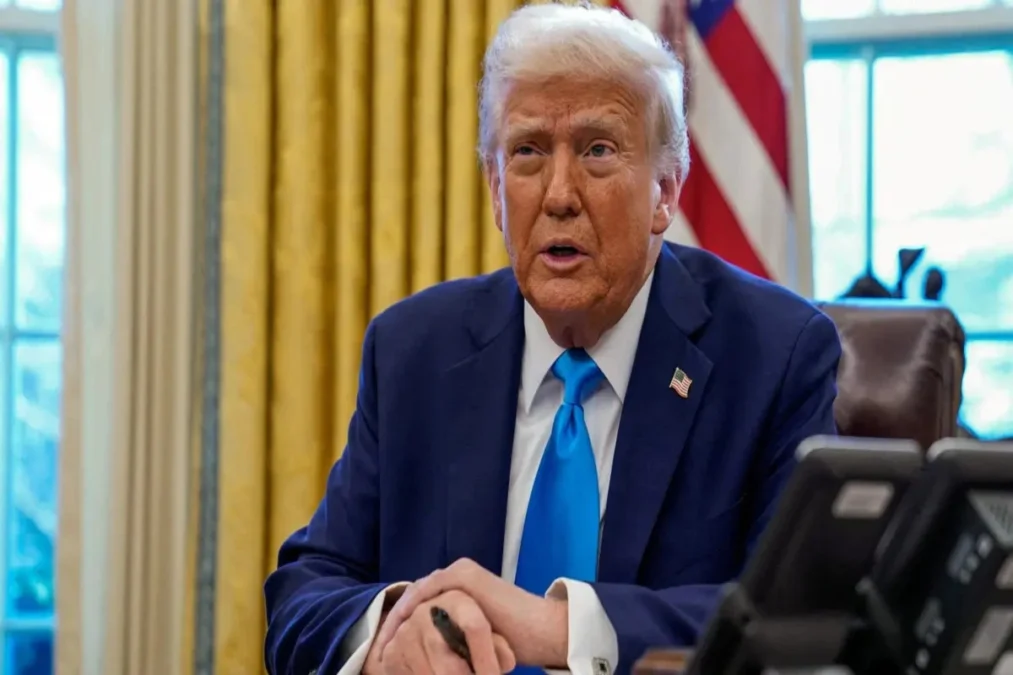
January 23, 2026: Donald Trump confirms an U.S. fleet deployment toward Iran. In the most dramatic U.S.-Iranian tensions the United States president, Donald Trump, has indicated that he has deployed what he has termed as a naval armada on Iran, a move that officials have said is aimed at deterring Tehran and sending a message to its military strength.
Trump, who had just come back to the World Economic Forum in Davos, Switzerland, on January 22, told reporters on Air Force One that a huge U.S. fleet deployment toward Iran was heading to the Middle East, although he emphasized that he hopes we will not need it. Trump said that “we had an “armada”, heading that way, and perhaps we do not need it. There are many ships going, you see, that way of it, just in case … I would not wish to have it happen, but we are keeping a very close eye on Iran”.

Military Movement And Calculating Strategy
According to the officials of the U.S. defense, on condition of anonymity, the aircraft carrier USS Abraham Lincoln and a number of guided-missile destroyers have been listed as some of the navy assets that will come to the Middle East in the coming days. It has also been indicated that more air-defense will be considered to be used in the region to defend the U.S forces and assets should any Iranian attack be advanced.
The relocation of the U.S. fleet deployment toward Iran follows the context of acute domestic unrest in Iran. In recent weeks, countrywide protests have roared due to economic hardship and political discontent, and this issue has prompted a strong reaction by Iranian security agencies. International rights organizations photograph thousands of people have been killed but exact numbers are disputed by the blacking of the internet as well as limited reporting.
The announcement by Trump would represent an extreme increase in the U.S. pressure against Iran but he is positioning the deployment as a deterring factor, and not the start of a war.

Rhetoric And Diplomacy Of Trump
Reiterating that there is no conflict with Iran, Trump highlighted several times that he did not desire to engage in war with Iran because of the immensity of the military movement. Perhaps, he said, we need not use the armada, and closed by saying that Washington is willing to talk.
Trump once more made his argument that previous warnings by Washington had assisted him in influencing Iran into halting plans to execute hundreds of political prisoners, but these claims have been dismissed by independent observers because it is hard to authenticate what is presented by the Iranian government.

Trump in a comment this week threatened Tehran to kill protestors or resume its nuclear program, he said the United States would hit it even harder than it has never been hit.
Nevertheless, Trump was diplomatically ready, admitting that Iran does want to talk, which may conclude as much as the internal disputes in Tehran and the outside pressure of other world powers. It has, however, proceeded as the U.S. fleet deployment toward Iran.
The Reactions And Regional Response Of Iran
Tehran has not kept its mouth shut. Iranian officials have even threatened that they are placing a finger on the trigger and they should not make miscalculations that may trigger an even larger conflict. The state media and spokespeople of the Iranian government have stressed on sovereignty and gave severe warnings of severe consequences in case of any foreign military action such as the U.S. fleet deployment toward Iran.
Related Stories

There have been mixed responses internationally regarding the U.S. fleet deployment toward Iran. Although the governments in Europe are harsh on the human rights situation in Iran, they have called on de-escalation and on engaging in diplomatic efforts to avert further destabilization of the situation in the region. Analysts observe that any open conflict between the United States and Iran will become a cause of broader instability in the Middle East.
Economic Impacts And Global Markets
The news about the naval build up and U.S. fleet deployment toward Iran has also backfired in the world markets. The effects of oil prices followed the remarks of Trump because the traders decided the chance of the disruption of one of the most energy-sensitive regions in the world. The price of the Brent crude futures increased by a lot on Friday after the statements but this time it was as a result of worry over any supply risk without an actual war.
Ahead Of The U.S. Fleet Deployment Towards Iran
In the meantime, the United States is embarking on the policy of strong military position and rhetorical willingness to negotiate. The positioning of the naval force and U.S. fleet deployment toward Iran, which included a carrier strike group, can be interpreted to mean that Washington is prepared to discourage the aggression of Iran- including the aggression- but the fact that the positioning of the force indicates the fragility of peace in a region that has experienced years of geopolitical tensions and occasional confrontations.
The situation, as Trump himself pointed out, is highly monitored, and the changes can occur quickly, according to his own words, based on the situation in Tehran and the response of the U.S. allies and opponents.
Also read: UAE Weather Today: What To Expect, Rain Probability, Temperatures And Atmospheric Trends