The federal budget for 2027 to 2029 is the UAE’s most ambitious three-year spending plan yet, and the breakdown tells a very deliberate story about what this country has decided matters most.
Governments reveal their true priorities not in speeches but in spreadsheets. When a cabinet sits down and decides how to distribute hundreds of billions of dirhams across a three-year horizon, the numbers that emerge are the most honest expression of national intent available. Everything else is positioning.
Related Stories

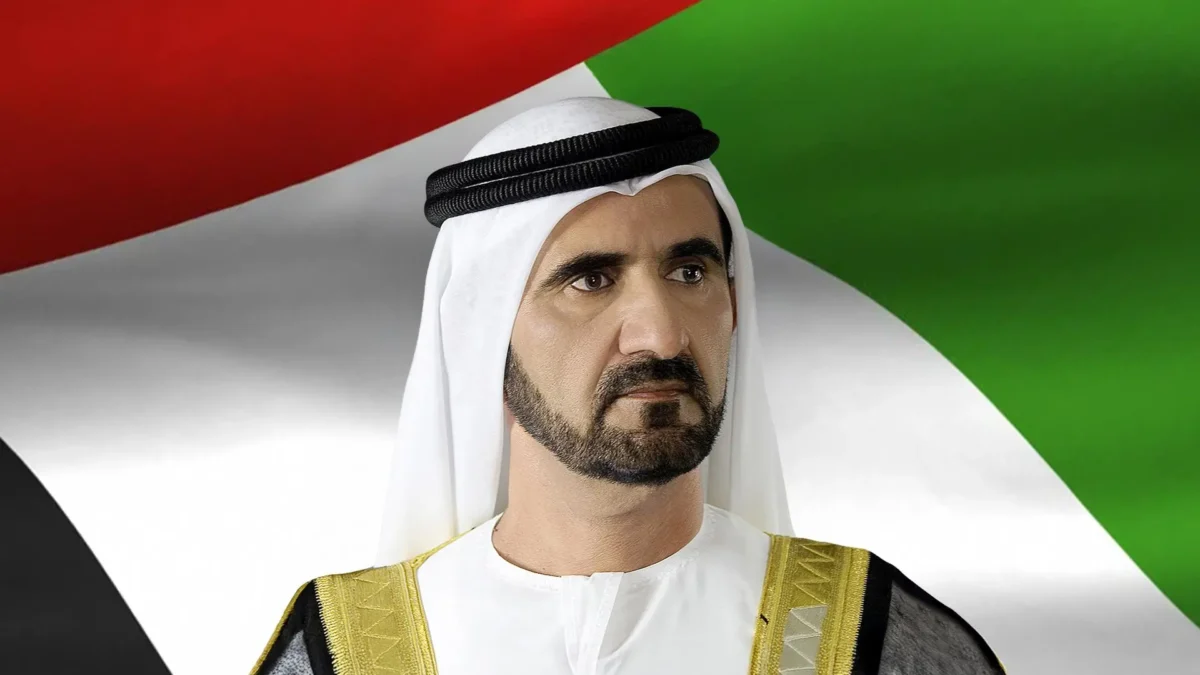
On October 12th, the UAE Cabinet, chaired by His Highness Sheikh Mohammed bin Rashid Al Maktoum, Vice President, Prime Minister and Ruler of Dubai, approved two interconnected decisions that will shape how the country spends the next three years. The Federal General Budget Plan for 2027 to 2029 carries a total outlay of Dh292.5 billion — a figure that, according to the Cabinet’s own accounting, represents a 28.3 percent increase on the preceding three-year cycle. The Federal General Budget for fiscal year 2027 alone stands at Dh90.1 billion.
Read those numbers alongside what Sheikh Mohammed said when he announced them: “Our priorities are fixed and have not changed: education, health, housing, social services, and the quality of life and stability of our citizens.”
Fixed priorities. Growing budgets. That combination is worth examining closely.
Related Stories

The 2027 Budget: Where the Money Goes
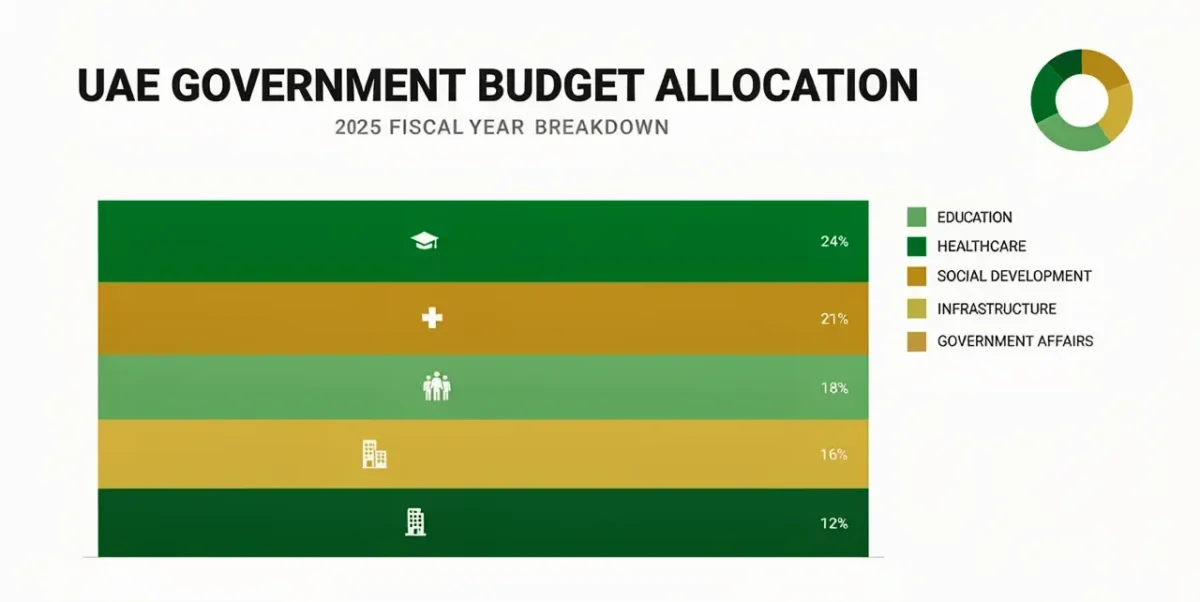
The Dh90.1 billion allocated for fiscal year 2027 is distributed across five broad sectors, and the proportions reveal as much as the totals.
Social Development and Pensions absorbs the largest single share: Dh34.6 billion, representing 38.4 percent of the entire federal budget. Within that figure, public and university education programmes alone account for 18.8 percent of the total budget — the single largest line item. Healthcare receives 6.7 percent. Pensions account for 6.4 percent. Social affairs receives 4.4 percent, and public services 2.1 percent.
Related Stories

Government Affairs takes the second largest allocation at Dh29.1 billion, or 32.3 percent of the total. Federal Expenses, the operational costs of running the federal government itself, receive Dh17.8 billion, representing 19.7 percent. Financial Assets and Financial Investments receive Dh5.6 billion, equivalent to 6.2 percent. Infrastructure and Economic Resources receive the smallest proportional share at Dh3 billion, or 3.4 percent.
The sectors covered by the broader three-year plan read like a blueprint for a country that has made a very specific choice about what kind of economy it intends to build: community protection, the economy of the future, future-oriented education, employment and empowerment, health and quality of life, leadership and international relations, industry, technology, energy, infrastructure, culture, media and sports.
The Number That Needs Context
Here is where careful reading produces an interesting question.

The 2026 federal budget, approved in October 2025, carried total expenditure of approximately Dh92.4 billion according to the UAE Media Office announcement at the time. The 2027 budget, at Dh90.1 billion, is marginally lower than its immediate predecessor — a detail that sits in some tension with the headline narrative of a 28.3 percent increase in the three-year total.
The explanation, most likely, lies in the composition of the two budgets rather than in any reduction of ambition. The 2026 budget allocated around Dh15.4 billion to financial investments, a significantly larger proportion than the Dh5.6 billion earmarked for the same category in 2027. If that reading is accurate, the apparent reduction in the 2027 total is not a contraction of service delivery or social spending, it reflects a deliberate shift in how the federal government is classifying and directing investment rather than a pullback in what residents will experience.
The social development and pensions allocation, at Dh34.6 billion, appears broadly stable between the two years. Education and healthcare allocations, the components that most directly touch the daily lives of citizens and residents, have not been squeezed.
His Highness Sheikh Maktoum bin Mohammed bin Rashid Al Maktoum, First Deputy Ruler of Dubai, Deputy Prime Minister and Minister of Finance, addressed the broader philosophy in his statement on the budget. The measure of a budget, he said, should not be the scale of its financial resources alone but the quality and scale of the sustainable impact those resources deliver across society.
That framing matters. It signals that the government is tracking outcomes, not just outputs, asking not how much was spent on education but whether educational performance improved, not just how much went to healthcare but whether health outcomes shifted.
AI, Data and the Architecture of Modern Government Finance
One of the most significant details in the budget announcement sits not in the sector allocations but in the methodology statement that accompanies them.
Sheikh Maktoum specifically highlighted the budget plan’s emphasis on harnessing artificial intelligence and financial data analytics to strengthen fiscal management and simplify requirements. The UAE’s new strategic planning cycle explicitly places digital transformation at its core, with the government committing to regional and global leadership in the adoption of advanced technologies across government and economic activities, and in planning and financial analysis.
This is not rhetorical. The UAE has already implemented AI-driven systems across multiple government departments, from autonomous vehicle permitting to judicial processes to building approvals. Extending that logic to federal financial management, using AI to identify inefficiencies, predict spending trajectories and allocate resources more precisely represents a qualitative upgrade in how a government of this scale manages public money.
Mohamed bin Hadi Al Hussaini, Minister of State for Financial Affairs, described the 2027 to 2029 plan as a significant shift in the management of public resources, designed to ensure greater agility and a more strategic approach to directing expenditure over the medium term. The coordination involved in building this budget, he said, focused on equipping federal ministries and institutions with tools and solutions for their operational and strategic objectives in line with the highest standards of governance and future readiness.
What This Means in Practice for Residents
Abstract budget figures become meaningful when translated into what they fund at the level of the individual.
An 18.8 percent budget share directed at education, the single largest line item in the entire federal budget — sustains the UAE’s school and university infrastructure, funds teacher training and curriculum development, and supports the Emiratisation of professional sectors through targeted education programmes. For the nearly one million students in UAE public schools and universities, this allocation is the structural commitment behind every classroom, every laboratory and every scholarship.
A 6.7 percent healthcare allocation maintains the UAE’s free or heavily subsidised healthcare system for citizens while supporting the broader public health infrastructure used by the entire country’s population. At a time when the Ministry of Health and Prevention is simultaneously implementing sugar and salt reduction regulations in packaged food, tightening obesity prevention frameworks and expanding digital health services, having the funding to back those ambitions matters enormously.
The infrastructure allocation at 3.4 percent may look modest by comparison, until you consider that the UAE’s federal infrastructure spending works alongside significantly larger emirate-level investments in roads, transport, utilities and urban development. The federal figure covers the national level; Abu Dhabi, Dubai and the other emirates fund their own infrastructure separately through their own budgets.

Three Years, One Direction
The UAE Federal Budget for 2027 to 2029 is not a dramatic change of course. It is a confident continuation of a direction the country has been travelling with increasing clarity for over a decade — investing in people, building institutional capability, maintaining fiscal discipline and using technology to make government smarter rather than simply larger.
What has changed is the scale of the commitment. Dh292.5 billion across three years, with the largest single share going to social development, education and healthcare, is a government telling its population something specific: the economic transformation we have been building is not a detour from human wellbeing. It is the means to it.
Sheikh Mohammed’s own words from the announcement carry the best summary of what the numbers are designed to express. “We are not spending simply to meet the needs of today. We are investing in a proactive government services ecosystem that exceeds expectations and reinforces the UAE’s global leadership.”
Dh292.5 billion is a very specific kind of ambition.