

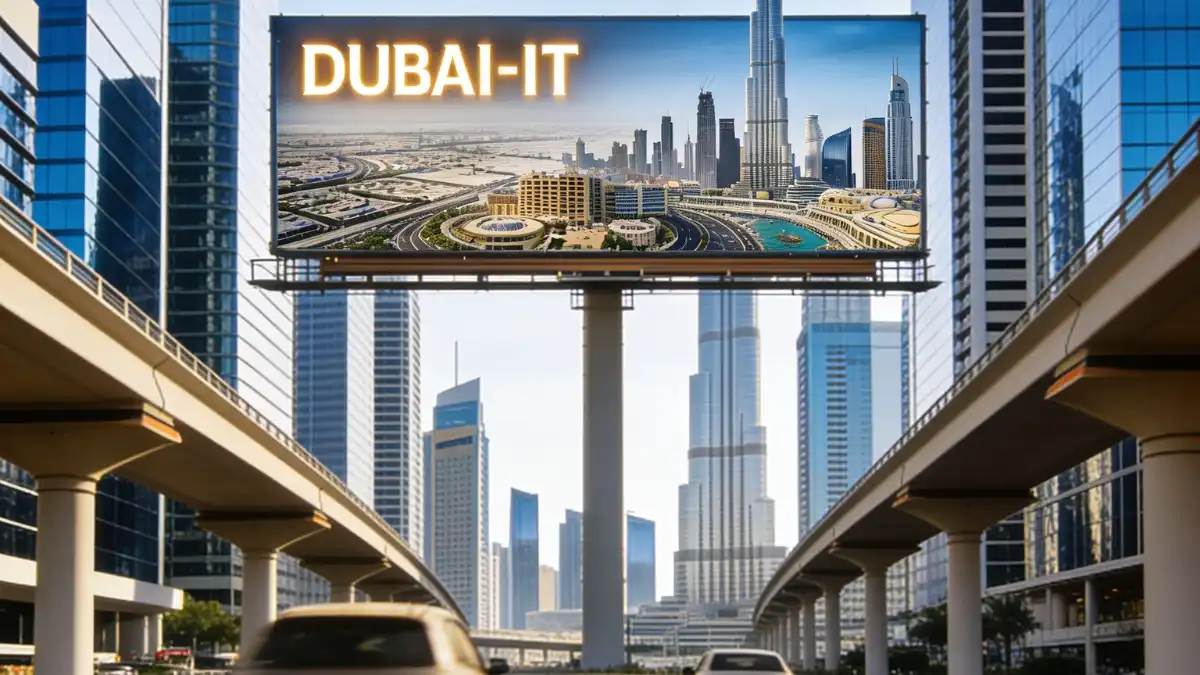
From highways and skylines to government offices and businesses, Dubai’s newest message is not a product, not a campaign slogan, but a mindset. Here’s what “Dubai-it” means, how it began, and why Dubai wants every generation to adopt it.
The Message You Notice Before You Understand It
You are driving across Dubai.
Related Stories
Glass towers reflect the afternoon sun. Digital billboards flash, one after another. And suddenly, among luxury ads and global brands, one message stands out—
“Dubai-it.”
Short. Unusual. Almost like a verb.
At first glance, it feels like branding. But in Dubai today, this phrase has become something larger—a public statement about how the city wants to think, work, and build in the years ahead.
What Is “DUBAI-IT”?
“Dubai-it” is a public initiative recently launched and introduced by His Highness Sheikh Mohammed bin Rashid Al Maktoum to define the philosophy of work in Dubai and disseminate it across all institutions, companies, and future generations.
The idea behind it is straightforward:
If something seems impossible, ambitious, or unusually large, then Dubai’s answer is to execute it quickly, precisely, and visibly.
According to the official messaging allowed around its launch, “Dubai-it” is:
- Swift achievement
- Exceptional execution
- Delivering measurable results
- Finishing ambitious goals in record time without compromising standards
In other words, this is how Dubai wants to convert its reputation into a method.
How Did This Start?
For decades, Dubai’s leaders have sought to fill each day with the city’s identity through fever-pitch transformation.
From becoming a global aviation hub to building large-scale infrastructure, business districts, tourism zones, and technology ecosystems, the city develops an international image around moving faster than traditional timelines.
Now, instead of presenting that as history, Dubai is packaging it into a repeatable philosophy.
“Dubai-it” was launched in an attempt to distill what was once a mere style of governance and development peculiar to Dubai into an attitude directly adoptable by organizations and citizens.
Why Is It Becoming Popular Right Now?
Partly because of visibility.
Dubai has increasingly embraced public storytelling, city branding, and large-format campaigns with ideas that shape anything into a public conversation. Outdoor messaging, digital screens, and civic initiatives are still very much in play and easily noticeable on the emirate’s urban canvas.
But “Dubai-it” is popular because people see themselves in it.
- Launching faster for entrepreneurs.
- Reducing delays for companies.
- Execution over process for government teams.
- A visible outcome and action-city culture for residents.
It is something that sounds usable—not just something inspirational.
What Does It Mean for People Living in Dubai?
For residents, “Dubai-it” is not about law or policy. It does not give birth to new duties or responsibilities.
Instead, it works in the cultural sense—think bigger, move faster, and deliver clearly.
Supporters consider it an extension of Dubai’s identity regarding encouraging innovation, entrepreneurship, and high standards.
At the same time, it reaches out to one of those broader contemporary-city transitions: moving from a long-term planning language toward public culture that is execution-focused.
The Bigger Question: Can A City Become a Verb?
Normally, cities are places. Dubai is up to something different. With “Dubai-it,” the city is presenting itself as an action—what things happen and how things happen.
Whether it lasts as a movement or remains just a powerful campaign, one thing is clear:
Dubai no longer wants the world to just look at what it built.
It wants to be asked—
How did they Dubai-it?
And maybe that answer is different for everyone.
For some, it’s the skyline. For others, the ambition, the speed, or the opportunities.
But if you ask me—
it might just be those incredibly smooth roads that make us feel like the entire city is only minutes away.
What is the one thing you love the most about Dubai?
Also Read: Sharjah Dubai Tunnel Opens a New Chapter for Commuters