

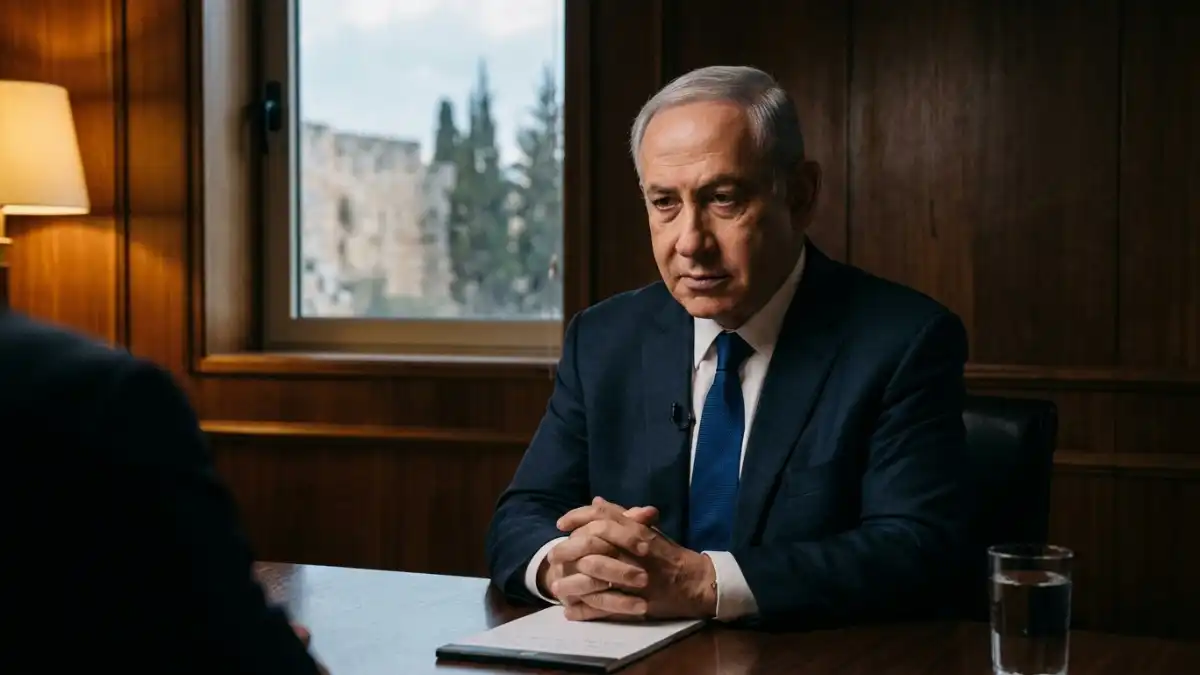
Israeli Prime Minister Benjamin Netanyahu has announced that he has undergone treatment for early-stage prostate cancer, admitting that he delayed publication of the medical report for two months during the war with Iran.
According to Netanyahu’s annual medical report published on Friday, the tumor was found at a “very early stage,” with no spread or metastases, and the problem has now been fully treated. Hadassah Hospital oncology chief Aharon Popovtser said follow-up imaging and blood tests showed that “the disease has disappeared.”
The prime minister opted for radiation therapy — a course of targeted treatment sessions that he reportedly approached with remarkable casualness. By his own account, he attended his treatment sessions, sat down with a book, and went straight back to work.
Wartime timing prompted Netanyahu to keep diagnosis private
Netanyahu said he had asked for the information to be withheld from the public so it would not be released “at the height of the war” against Iran and fuel what he called “more false propaganda against Israel.”
The Israeli prime minister has insisted that physicians told him the condition was minor and common for men his age, and that he could either monitor it or treat it immediately.
“You already know me. When I’m given information in time about a potential danger, I want to address it immediately. This is true on the national level and also on the personal level,” he wrote in a post on X.
More Read

Speculation mounted after Netanyahu skipped key security meetings
The 76-year-old leader previously underwent surgery for an enlarged benign prostate in 2024 and had since been under routine monitoring, during which the tumor was discovered. It remains unclear exactly when the treatment took place, and his office said the rest of the medical report showed him to be in good health.
The disclosure follows after weeks of speculation about Netanyahu’s health after he missed several consecutive security cabinet meetings during the early phase of the US-Israel war with Iran.
In March, he released a bizarre video of himself waving his hands during a visit to a Jerusalem cafe in an apparent effort to quash rumors that recent videos of his public appearances were AI-generated.
Netanyahu’s recent medical history
In July 2023, Netanyahu was fitted with pacemaker after he was urgently admitted to the hospital because of what doctors said was a “transient heart block.” One week earlier, doctors said he had a “fainting episode,” though his office only said he had experienced dizziness. Since he was sedated for the operation to insert the pacemaker, he appointed a minister to temporarily take his place.
In March 2024, Netanyahu underwent surgery to treat a hernia. He had a similar surgery 11 years earlier.
Israel’s PM Faces Declining Approval Ratings
Netanyahu’s disclosure about his health comes at a highly sensitive time in Israeli politics. His approval ratings have declined significantly since the onset of the Iran conflict, and with national elections set for October, concerns over his ability to lead could have tangible electoral consequences.
Speculation about his health had been mounting for months prior to Friday’s announcement. His absence from several key security cabinet meetings during the early stages of the conflict fueled rumors that extended far beyond Israel. Iranian state media even circulated AI-generated images falsely claiming the prime minister had died.
In an apparent effort to counter these claims, Netanyahu released a video in March showing himself at a café in Jerusalem — a simple yet pointed move to reassure the public that he remained alive, engaged, and firmly in charge.
What’s next
Medically, Benjamin Netanyahu’s prognosis appears positive. prostate cancer, when identified at this stage particularly in men of his age is common and highly treatable. Doctors anticipate ongoing routine monitoring, and his office has stated that the diagnosis will not interfere with his official responsibilities.
Politically, however, the issue may prove more enduring than the illness itself. Questions remain over who was informed and when, and what duty a sitting prime minister has to disclose such a diagnosis to the public and even to members of his own government. It also raises a broader concern: does withholding this information, even briefly and for strategic reasons, breach the standards expected in a democratic system?
Netanyahu concluded his announcement with a straightforward message to the Israeli public: prioritise your health. Coming from a leader who managed a cancer diagnosis while overseeing a nation at war.