As artificial intelligence reshapes industries and workplaces, a Dubai gathering highlights women’s leadership in the UAE in the decisions ahead.
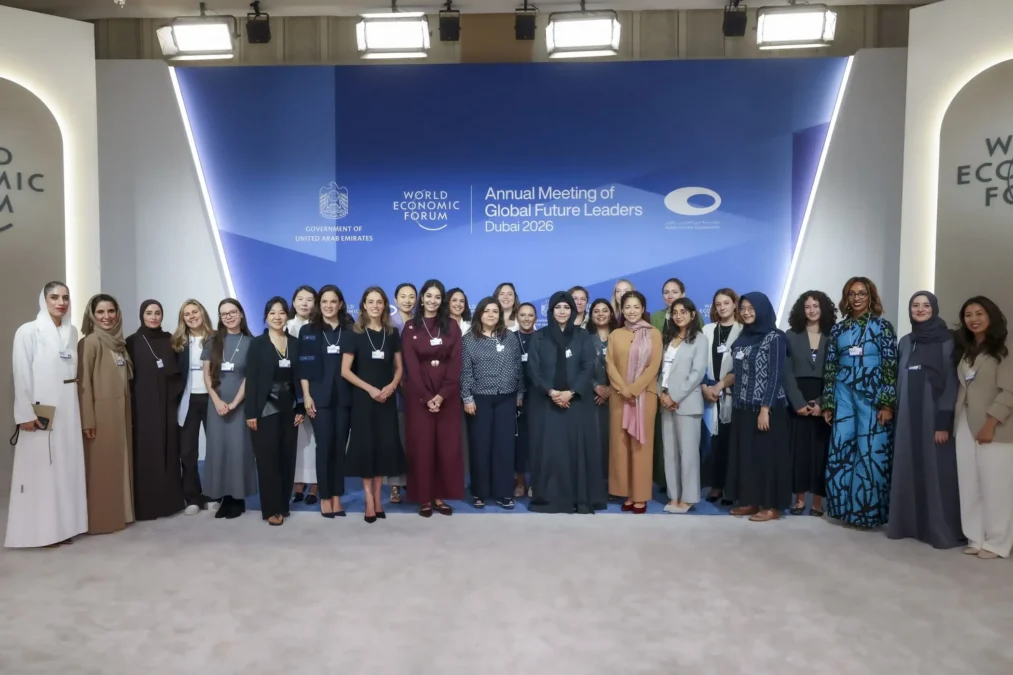
Who gets a say in the future of work? Who helps decide how technology is used, where investment goes and which ideas receive the backing to grow? These questions sit at the centre of the debate around women’s leadership, and they formed part of a gathering hosted by Sheikha Latifa bint Mohammed bin Rashid Al Maktoum in Dubai on October 15.
Related Stories

The Chairperson of Dubai Culture and Arts Authority brought together 29 women leaders representing 22 countries for the Women Leading the Future majlis. The discussion took place during the Annual Meeting of Global Future Leaders 2026, organised through a partnership between the UAE Government, the World Economic Forum and the Dubai Future Foundation.
The gathering brought women from different professional and national backgrounds into the same conversation, with subjects ranging from science and technology to finance, entrepreneurship, culture and social change. But the timing matters. With artificial intelligence beginning to influence everything from recruitment to everyday working practices, leadership is no longer only about who holds senior positions. It is also about who helps shape the systems that increasingly affect people’s lives.
AI is changing the conversation around women at work
Technology was an important part of the discussion, especially its growing influence on work and life. Sheikha Latifa highlighted women’s leadership in the UAE and their contribution to scientific and technological progress, and investing in knowledge.
Related Stories

That investment has consequences beyond individual careers. Women need opportunities to contribute to the development and use of new technologies, not simply adapt to changes decided elsewhere. Access to relevant training, professional networks and leadership roles can influence whether they are able to participate in industries that are being reshaped by innovation.
The same question applies to organisations adopting AI. New tools may change how candidates are assessed, how employees are promoted and how decisions are made. The technology alone does not guarantee fair outcomes; the people designing, selecting and supervising these systems matter too. For that reason, discussions about women’s leadership in the UAE increasingly overlap with accountability, representation and access to opportunity.
Related Stories

The UAE conversation is moving into workplaces
The majlis comes amid other UAE initiatives addressing gender balance, including efforts to encourage companies to strengthen women’s participation in decision-making.
On October 1, the UAE announced the winners of its inaugural SDG 5 Pledge Awards, recognising organisations for work related to gender-balance policies, women’s representation in leadership, initiatives to advance equality and family-focused employment practices. Standard Chartered UAE, ADNOC, Schneider Electric and Deloitte Middle East were among the recognised organisations The awards matter because gender balance is not determined by public statements alone. It is also shaped by everyday workplace decisions: who is considered for a senior role, whether employees can progress without sacrificing family responsibilities, and whether women have a meaningful place in strategic discussions.
A separate conversation at the Global Future Leaders meeting on October 14 took up a related challenge. During a session titled Fair by Design, Huda Al Hashimi, Deputy Minister of Cabinet Affairs for Strategic Affairs, spoke about the gap that can emerge between commitments to fairness and their implementation. The discussion also addressed the risk of bias in AI-driven hiring and promotion systems, alongside the need for representation and measurable accountability.
Related Stories

Together, these developments point to a practical question for employers: how can they demonstrate that their policies are changing outcomes, rather than simply existing on paper?
Leadership needs more than a seat at the table
For the women attending Sheikha Latifa’s majlis, the subjects under discussion extend across sectors and national borders. Their experiences may differ, but the issues raised, technological change, investment, sustainability and social cohesion influence how communities and economies develop.
Sheikha Latifa also emphasised collaboration across sectors and the importance of wider participation. That matters because many of the challenges facing future leaders cannot be handled by one industry or institution alone. Progress in technology, for instance, is connected to education, employment and the way public and private organisations make decisions.
The wider annual meeting, held from October 13 to 15, brought together more than 700 leaders and experts from 100 countries. Participants included ministers and officials, around 300 Young Global Leaders and 150 UAE government leaders. The majlis was one part of that broader programme, but its subject reaches well beyond a single event. As the future of work and technology takes shape, the choices made by today’s leaders will influence who gets access to opportunity — and who has a hand in defining it.
For women’s leadership, the challenge is not only to be present in those conversations. It is to have the authority, resources and influence to help determine what happens next.