

The Fuel Price Committee announced the new deregulated UAE fuel prices for June, resulting in a noticeable fuel price increase across all major petrol variants. The prices per litre will rise at retail stations nationwide from June 1, 2026.
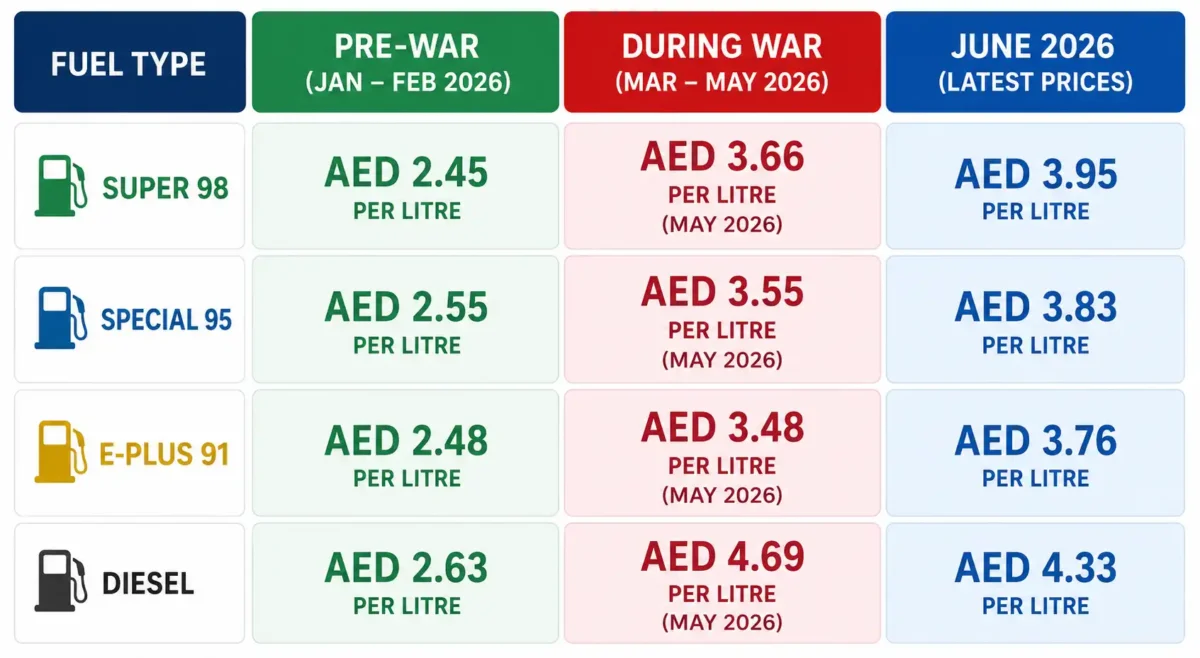
The new schedules, which were approved, have increased the price of the premium Super 98 petrol by 29 fils to AED 3.95 per litre. Likewise, Special 95 petrol will sell at AED 3.83 per litre, and E-Plus 91 petrol at AED 3.76 per litre. Remarkably, however, the industrial transportation saw a quick reprieve with diesel dramatically cutting back the price trend from the higher rate to AED 4.33 per litre.

The broad-ranging changes to UAE fuel prices for June are a major development for logistical networks and individual pocket book calculations and are a testament to the ongoing unpredictability of the local retail fuel fuel distribution channels.
UAE Fuel Prices: A Closer Review of May Rates
To understand the scope of the current fuel price increase, consumers must examine the base numbers left behind from the previous month. Throughout May 2026, UAE fuel prices for June were built upon a slightly less expensive foundation. Last month, Super 98 was locked in at AED 3.66 per litre, while Special 95 and E-Plus 91 cost motorists AED 3.55 and AED 3.48 per litre respectively. Conversely, diesel was much more expensive in May, forcing commercial fleets to pay a steep AED 4.69 per litre.
This dramatic monthly variation demonstrates why the local population monitors the committee’s updates so intently. The newest shift means that filling up a standard 60-litre family vehicle with Special 95 will now require an extra investment, driving real concerns over how the persistent fuel price increase could influence broader consumer inflation metrics across the country.
Related Stories

As UAE fuel prices for June settle into the retail market, drivers are actively looking for efficient ways to optimize their daily commutes before summer heat begins to spike accessory cooling consumption.

Pre-War Baselines vs. Ongoing Conflict Peaks
Evaluating the current trajectory of UAE fuel prices for June requires a deep dive into the historical macroeconomic milestones of early 2026. Prior to the severe outbreak of the regional geopolitical conflict between Israel and Iran, the local commodity landscape was resting on highly stable baselines.
Related Stories

During the pre-war period of January and February 2026, retail costs were remarkably low; Super 98 hit a minor low of just AED 2.45 per litre in February. This affordable era provided ample relief for transport operators, hiding the extreme market shifts that were quietly building on the global horizon.
The entire pricing landscape changed dramatically during the wartime periods of March, April, and May 2026. Following the initial geopolitical escalations in March, energy markets absorbed a sharp shock, causing local pump rates to experience an uninterrupted fuel price increase month after month. Super 98 jumped to AED 2.59 in March, soared to AED 3.39 in April, and continued its upward path to AED 3.66 in May.
This means that compared to the quiet pre-war months of early winter, the UAE fuel prices for June have surged by nearly 60 percent. This rapid transition shows how vulnerable deregulated local pricing systems are when navigating multi-month geopolitical crises.
Related Stories

UAE Fuel Prices: War Pressures
The critical question for economists is whether this aggressive fuel price increase is driven directly by regional warfare or by structural adjustments in international Brent crude baselines. Because the Ministry of Energy deregulated local fuel policies in 2015, the actual figures inside UAE fuel prices for June are calculated using a strict, rolling monthly average of international refined product costs rather than immediate spot prices.
Throughout most of May, the intense geopolitical conflict applied heavy pressure to critical maritime shipping corridors, causing international Brent crude averages to hold at an elevated $103 to $106 per barrel, which naturally forced the local rate up.
Although Brent crude began cooling off significantly in late May, dropping down toward $91 per barrel due to positive progress in diplomatic talks, the calculation matrix evaluated the cumulative, higher averages of the entire month. This lag explains why a major fuel price increase is hitting pumps right now, even as international oil baselines start to cool.
Consequently, the high rates found within UAE fuel prices for June are a combined result of past wartime premiums and high monthly crude averages. If international prices manage to hold their current lower positions underneath the $100 mark throughout next month, drivers can reasonably look forward to a reversal of this painful fuel price increase when the July schedules are finally processed.

Read More: The UAE Summer Survival Hack Everyone Seems to be Following