
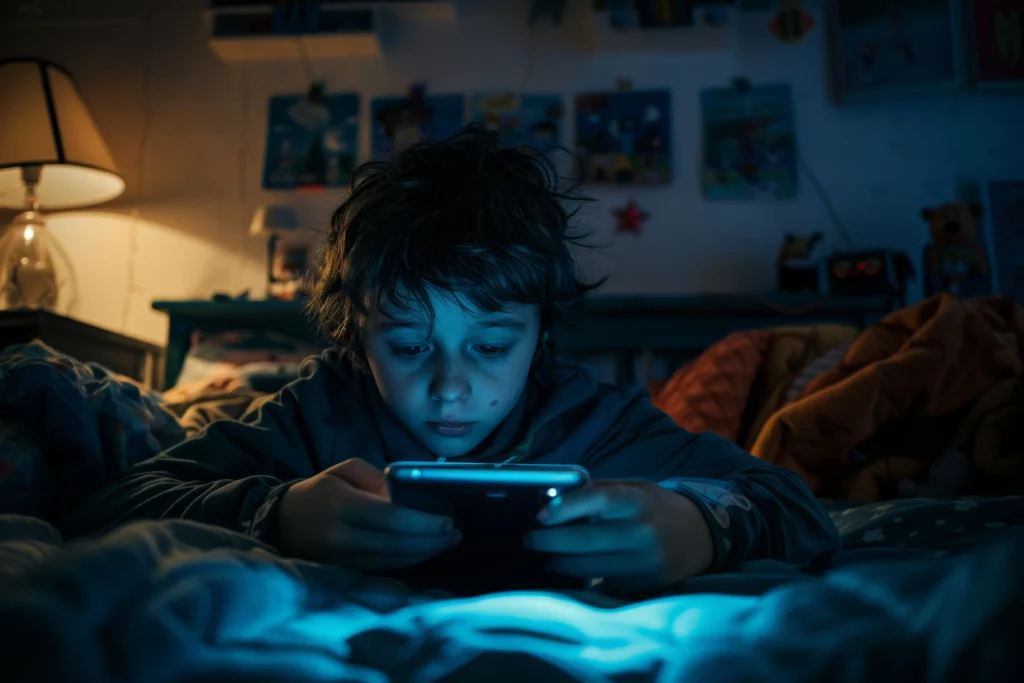
The following are the effects of increasing screen time on children—namely, sleepless nights, short tempers, and poor concentration and what parents can do in response to them.
In any mall or restaurant in the UAE, you will see a child leaning a tablet against the ketchup bottle. It seems innocent enough, but doctors say that screen time among UAE children is now appearing in clinics. As reported by The National, specialists have noticed an increase in cases of children suffering from problems associated with too much screen use, and parents are beginning to feel the pressure.
Related Stories

What Doctors Are Seeing
Mrs. Sudha Rao, who is a specialist in child medicine at Aster Clinic in Al Jaddaf, states that there has been a significant increase in children coming in with sleep problems. She also refers to “digital tantrums,” meaning the outbursts that occur when a device is taken away. For a great many families, screen time for children in the UAE has slowly become a daily cause of arguments at bedtime.
The Sleep Problem
It is during sleep that the effects are first apparent.
A study from Saudi Arabia involving 500 children between the ages of 6 and 12, mentioned in the report, showed that 66.7% of those who used screens for more than four hours a day had difficulty in falling asleep, whereas only 9.5% of children who used them for less than an hour experienced such problems.
Related Stories

Although the statistics are from the region and not from the UAE, they are in agreement with what local doctors say. The screen time of UAE children during the late hours can disrupt their body clock and leave them tired and irritable the following day.
Focus and Learning
Attention is also affected. The school studies referred to by Dr Rao show that children who have less than two hours of recreational screen time each day score 20 to 25 percent higher in attention and memory tests than those who have more than four hours.
Related Stories

Problems noticed in class are feelings of tiredness, poor concentration, and difficulty in coping with frustration. For children in the UAE with a high amount of screen time, conversation, imaginative play, and time spent outdoors are all reduced.
Not All Screen Time Is Equal
The situation depends on the context. Helen Pereira-Raso, who is a school superintendent in Dubai, stated this plainly: “It is not possible to regard all screen time as being the same.” For example, spending hours watching videos is quite different from using a tablet for research or as part of a group project.
Nevertheless, a 2025 study of 300 children in the UAE aged between 4 and 17 found that 37.7 percent of them spent more than seven hours on screens each weekday outside of lessons, and most of these children carried out no physical activity. This shows that screen time among children in the UAE is not a minor issue.


What Parents Can Do Today
The doctors are not calling for a complete ban. Instead, they recommend a number of simple habits to get UAE children’s screen time under control:
- Leave your phones, tablets, and consoles outside your bedrooms while you’re sleeping.
- Prepare the devices for charging in a shared area one or two hours before going to bed.
- Make mealtimes screen-free.
- Make the times at which the stops end predictable and issue a warning before these times arrive.
- Set off timers and provide an alternative, for example, by going outside or playing with a pet.
- When you feel frustrated, stay calm, but do not lower the limit you and the other person agreed on.
- Leave your own phone behind as well, since children imitate what they see.
The Bottom Line
A number of schools are taking action; for instance, Gems International School in Dubai Hills requires that personal phones remain “on site and out of sight.” It is more effective to introduce small rules than to make lengthy speeches.
Begin with the bedroom, then move on to the dinner table, and ensure that screen time for children in the UAE is treated as a conversation not a quarrel.
Also Read: Sheikh Hamdan Honours SWS Board Technology with the Dubai-it Award

