
As the US-Israel conflict with Iran reshapes the region, many are asking the same question — how is Iran fighting against some of the world’s most powerful nations?
It’s an obvious question. Iran is not the wealthiest country in the world. It doesn’t even have the most advanced military technology. And it certainly isn’t a global superpower by any conventional measure. And yet, as things stand right now, we’re watching a nation of roughly 85 to 90 million people command the attention of the United States, Israel, and the entire international community all at once. So what exactly is going on?
Related Stories

How is Iran fighting the US and Israel? Geography is everything
All you need to do is take a look at a map. Iran sits right beside the Strait of Hormuz — a narrow stretch of water, barely 30 kilometres wide, squeezed between Iran and Oman. Roughly 20 percent of the world’s entire oil supply passes through this single chokepoint. Just by the virtue of being where it is, with no real contribution of its own, Iran is at an advantage. It doesn’t need to fire a single missile to rattle global energy markets. The mere possibility of disruption is enough. And if you’ve been watching oil prices lately, you’re already seeing that play out in real time.
Why the US and Israel attacked Iran
The short answer is Iran’s nuclear programme. For many years, the United States and Israel have been closely watching Tehran’s nuclear and missile capabilities,and both seem to have reached the conclusion – a nuclear-armed Iran would fundamentally destabilise the region.
Iran has always maintained that its nuclear activities are peaceful, focused on energy and scientific research. That position hasn’t changed. But tafter the United States withdrew from the 2015 nuclear agreement, trust collapsed and the two sides never quite found their way back to the table. And after the recent military action, the diplomatic route effectively shut down until now when a fragile temporary ceasefire is hinging precariously on talks.
Israel’s calculus is different from Washington’s, and worth understanding separately. Given its small geographic size, Israeli policymakers have long viewed a nuclear Iran not as an abstract risk but as an existential one. That’s why Israel’s approach has been more direct. From targeted strikes, to intelligence operations, there have been sustained efforts to slow Tehran’s programme down.
The United States, meanwhile, is playing a longer game. American strategic interests in the region involve preventing nuclear proliferation across the Middle East, protecting global energy supply chains, and maintaining relationships with longstanding regional allies — including both Israel and the Gulf states.
Why the UAE and Gulf countries are caught in the middle
This is the part that matters most. Several Gulf nations, including the UAE, host US assets, logistics infrastructure, and energy facilities that are deeply embedded in the broader Western strategic network. In the current conflict, Iran has not limited its response to a single nation — it has targeted infrastructure and military positions across multiple locations. However in the UAE, Iran has not only attacked US assets but also civilian facilities like hotels and airports. Energy infrastructure across the Gulf was also targeted.
Iran’s fighting strategy
Analysts describe this as “regional spillover.” When a conflict involves global superpowers and their allies, the geography of that conflict tends to expand beyond the two parties directly involved. The UAE despite not being directly involved in the conflict has consistently faced and combated a barrage of attacks since the conflict began on February 28th 2026. In fact, the country has endured the highest number of attacks from the Iranian side and yet managed to thwart them all, suffering collateral damage to a minimum by all measure. This has shown the defence preparedness of the highest level and reinstated the faith in UAE’s robust infrastructure and resolve to protect its sovereignty.
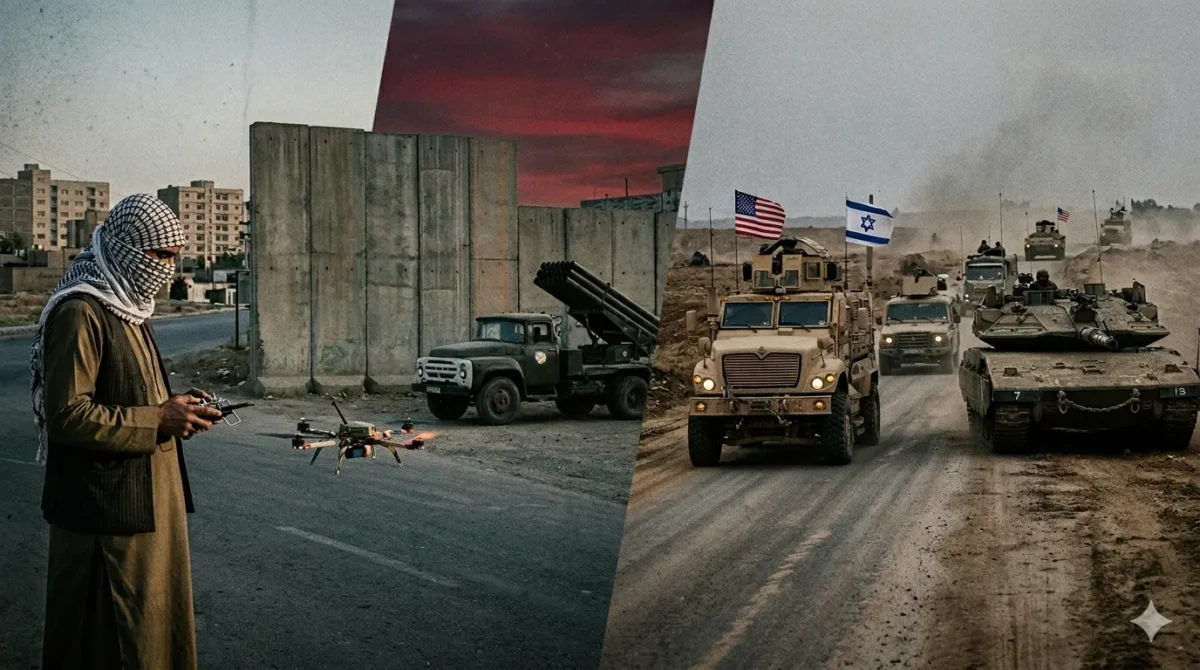
Here’s what many people miss. Iran was never going to compete with the United States tank for tank, jet for jet. It doesn’t try to. Instead, Iran has spent decades building something harder to confront directly — an arsenal of missiles and drones, influence networks stretching across Iraq, Yemen, Lebanon and beyond, and the demonstrated ability to apply pressure across multiple theatres simultaneously, as per multiple reports.
Military analysts call this asymmetric warfare. Rather than one decisive confrontation, the strategy is to create friction across an entire region — costly, unpredictable, and difficult to resolve cleanly. It’s why this crisis feels so layered, and why it has no obvious ending.
The economic reality
Years of international sanctions have significantly constrained Iran’s economy and cut off much of its access to global trade and finance. The contrast with the UAE and Saudi Arabia among the most economically open and globally integrated nations in the world could not be more stark.
A weakened economy has not stopped Tehran from pursuing its regional agenda. But it does offer important context for why Iran operates the way it does.Through proxies, unconventional tactics, and deliberate escalation rather than sustained conventional engagement.
The bigger picture
Stripped of the noise, here is where things stand. The United States remains the world’s dominant military power. Israel is among the most capable defence and intelligence forces on earth. The Gulf states are central pillars of the global economy. And Iran is a country that has, for decades, chosen confrontation over integration and is now facing the consequences of that choice, even as it continues to cause disruption across the region.
That’s why the world is watching. And for those of us living here, understanding the moving parts isn’t just useful — it’s necessary.
Real Also : War, Uncertainty & Influence: How Dubai’s Creator Economy is Recalibrating