
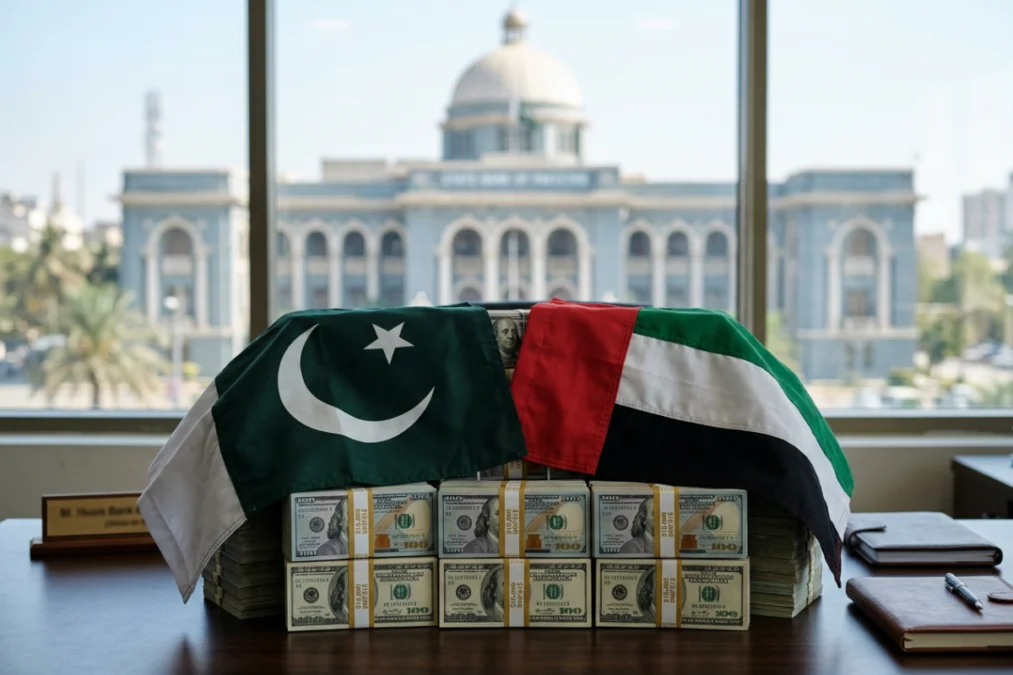
Pakistan’s borrow-deferral cycle with the UAE comes to an end after nearly three decades, marking one of the most significant debt events in the history of the two countries. Pakistan repays the UAE $3.45 billion debt to the Abu Dhabi Fund for Development (ADFD) in full, confirmed by the State Bank of Pakistan. The whole repayment unfolded in three installments across April 2026.
Where the Debt Came From
$3.45 billion is not a single loan but an amount that has accumulated over three decades in three different borrowings. The debt roots back to 1996 when Pakistan took a loan of $450 million for one year. However, it was never truly settled. This oldest component of loan became an obligation that remained for nearly 30 years.
Related Stories
Former prime minister Imran Khan’s government delayed IMF negotiations in 2018. In response, the largest loan of $2 billion was approved by the UAE, to stabilize Pakistan’s declining foreign exchange reserves. A third tranche of $1billion followed this in 2023, extended to help Pakistan meet the requirements of IMF bailout programme.
The UAE charged a 3 percent interest rate in 2018, which later increased to 6.5 percent. Pakistan requested to return the rate to the original 3 percent, which the UAE refused.

Why Abu Dhabi Said No
Rollover refers to an agreement to extend a loan’s repayment deadline and not demand the money back immediately. Over the past several years, the UAE has extended its courtesy to Pakistan annually. While paying the interest, Islamabad parked the funds in its central bank.
These rollover periods were later reduced from annual to just one month each time. This was a clear signal that the UAE wants the money returned. The ignorance of these repeated hints prompted the UAE authorities to set a deadline of April 2026 for full repayment. Earlier, Pakistan requested for a two-year extension at a lower interest rate, UAE rolled over two $1 billion loans for one month only.
Pakistan’s Federal Minister, Muhammad Aurangzeb made a statement in February 2026 claiming that there was “no shortfall in external financing”. Pakistan ultimately used another Saudi financing to repay the final installment on April 23.
The widely believed reason that has accelerated Abu Dhabi’s decision is the escalating war that placed UAE under direct regional threat as well as introduced economic uncertainty across the Gulf.
A Matter of National Pride
Pakistan’s government found itself backed into a corner as Abu Dhabi recalled its funds instead of extending on its preferred terms. This repayment was a matter of national pride rather than just a financial compulsion.
Prime Minister Shahbaz Sharif has previously acknowledged the cost of dependence on foreign loans, who publicly said that it has caused Pakistan to bow its head and compromise its self-respect.
Pakistan Repays the UAE; How?
Pakistan’s own reserves were not sufficient alone. Officials confirmed that a fresh Saudi financing aided in repaying $2 billion, bringing the total payments to $2.45 billion within the same week. The remaining $1 billion was repaid on April 23 with the help of another Saudi financing. “This completes the repayment of total deposits of $3.45 billion to UAE,” State Bank of Pakistan confirmed via a post on X.
In parallel, Saudi Arabia extended its existing $5 billion deposit with the SBP by two years. This includes the $3 billion deposit which was signed at the IMF-World Bank Spring Meetings in Washington. The extensions prevented reserve outflows but did not directly fund the loan repayment.
Moreover, through Eurobond issuance, Pakistan also raised $500 million to support reserves. Pakistani Federal Minister of Finance said the government is actively exploring additional bilateral support to fill the void left by the UAE facility.
External Position of Pakistan and UAE
As Pakistan repays the UAE loan, the country’s reserves currently stand roughly at $15 billion. This covers nearly 2.8 months of imports, which are described as critical by the finance minister. However, officials have reassured that the repayment will not have any negative impact on the reserves. By extending its $5 billion deposit while facilitating Pakistan to clear the UAE obligation, Saudi has proved to be an effective replacement.
The recall of funds is a recalibration for the UAE rather than a rupture. Abu Dhabi is reportedly open to discussions regarding the conversion of its Pakistan exposure into a long-term infrastructure investment. This could transition a politically sensitive financial dependency into a mutual economic partnership.

The course these discussions take depends on how both countries manage the aftermath of debt repayment. The true challenge will be Pakistan’s ability to diversify its financing base, maintain its reserves, and meet IMF targets without Gulf deposits it has majorly relied on. All that’s left to see is whether this month marks the end or a pause before the next dependency cycle begins.
Read More: https://timesofdubai.ae/difcs-ai-native-vision-sparks-a-new-era-in-global-finance/