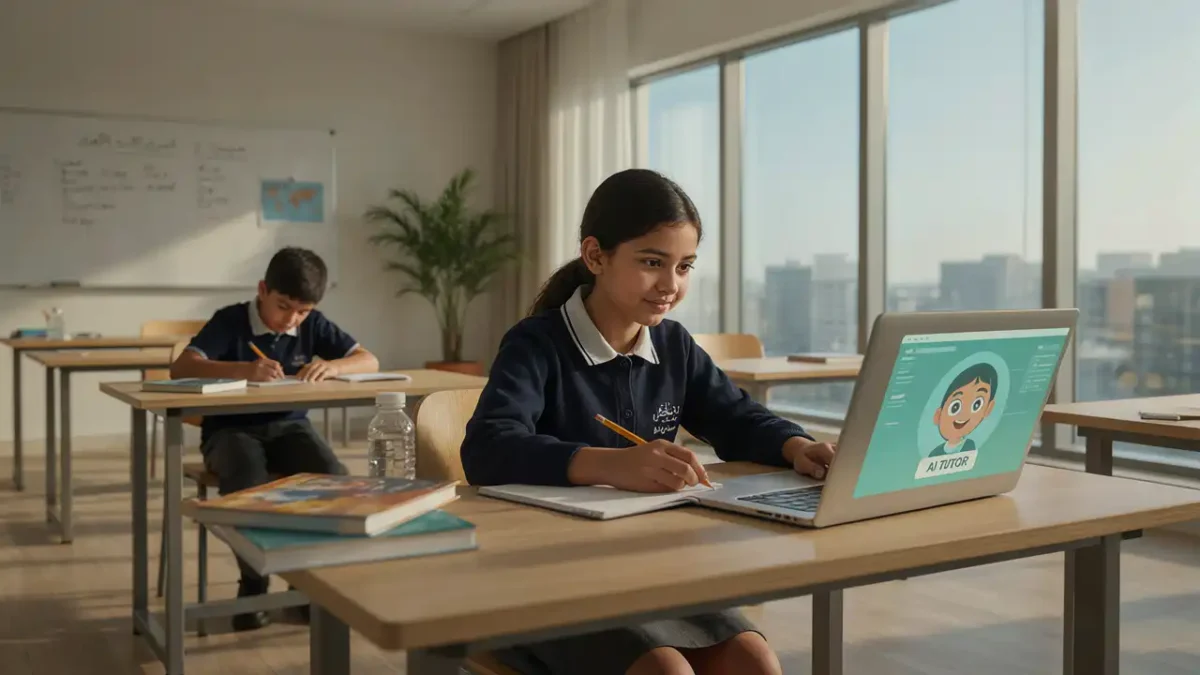
GEMS Education and AI company Napster are developing digital teacher personas that could give students personalised, multilingual learning support beyond school hours, with teachers still firmly in the loop.
Imagine it is 9:30pm. You have an exam tomorrow, your textbook is open, your notes are somewhere between three WhatsApp chats and a half finished Google Doc, and the one thing you actually need is the explanation your teacher gave in class that morning.
Related Stories
Except the teacher has gone home.
GEMS Education is now exploring a rather futuristic answer to that familiar student problem. The UAE’s largest private school education group is partnering with AI company Napster to develop digital personas and AI agents based on teachers’ subject expertise. The idea is to make approved, teacher informed learning support available beyond normal school hours and, potentially, in multiple languages.
But before anyone imagines a classroom full of screens with AI teachers replacing humans, there is an important distinction. That is not what GEMS says it is building. The stated aim is to extend teachers’ reach, not replace teachers.
Think of it as your teacher’s knowledge, with longer office hours
The most interesting part of the project is not simply that GEMS wants to use AI. It is how the AI is supposed to learn. The planned digital twins would be built around teachers’ own subject knowledge and approved educational material. That could eventually allow students to access teacher informed explanations, guided practice and learning support when the actual teacher is not available.
So, theoretically, the dreaded “I understand everything except this one chapter” moment could have somewhere to go after the school bell. The technology is also being explored for personalised skills development, formative feedback, communication and presentation practice, reflection and goal setting. For students, that could mean something considerably more useful than simply asking a generic chatbot to explain a textbook paragraph.
The difference is context. A general AI tool does not necessarily know what your school has taught, what your teacher expects or which learning material has actually been approved. A teacher informed digital persona potentially could.
No, your teacher is not being digitally replaced
This is the part that needs to be crystal clear.
GEMS has explicitly said the initiative is designed to extend the reach and impact of its teachers rather than replace them. The development process is also expected to include safety protocols, guardrails and human oversight, with educators able to intervene when required. That makes this less “AI teacher takes over the classroom” and more “AI becomes another layer around the classroom.”
And that distinction matters even more when the students involved are children and teenagers. The partners say safeguarding, age appropriateness and human oversight are being considered from the beginning rather than added after the technology is built. Usage and engagement will also be assessed to determine whether the tools are genuinely improving learning outcomes.
In other words, the experiment still has to prove that the technology is useful.
The first testing ground is already taking shape
The first phase will be based at GEMS School of Research & Innovation in Dubai. Its GEMS Global Education AI Hub and GEMS Intelligence 360 platform will provide the environment for teachers, students and partner organisations to co design, test and evaluate the technology. The initial experiments will go beyond digital teacher personas. They include gamified learning tools, AI assisted content creation, classroom simulations and the digitalisation of instructors. The idea is essentially to test different ways AI can fit into education before deciding which applications actually deserve a place in everyday school life.
GEMS and Napster are targeting a working solution before the end of 2026, with the longer term ambition of expanding successful applications across GEMS schools in the Middle East and other markets. That does not mean every GEMS student is about to receive an AI version of their teacher. The current project is a development and evaluation phase, with broader deployment dependent on what the testing shows.
And then there is the slightly unexpected name behind the project
There is an amusing twist hiding in this story. The company building this technology is called Napster.
Yes, that Napster.
The name that once became synonymous with music file sharing has re emerged as an AI company focused on digital personas and access to expertise. Its current Dubai based operation is now working with GEMS on education rather than music. It is an oddly perfect example of how quickly technology can reinvent itself. A company once associated with changing how people listened to music is now exploring how AI could change how students access knowledge.
And students are probably the generation least surprised by the idea.
The UAE is already preparing students for an AI heavy future
GEMS’ experiment does not exist in isolation.
The UAE is expanding AI’s role in education more broadly, including a national push around AI curriculum and educator training. Recent measures include plans to train 22,000 educators to use AI in areas such as teaching, assessment, curriculum analysis and lesson planning.
That makes the GEMS project part of a much bigger shift. The question is gradually moving away from “Should schools use AI?” and towards something more practical:
Where exactly should AI be useful in a school?
Should it help students practise?
Can it provide feedback without doing the work for them?
Can it help a student who is struggling without turning into a shortcut for homework?
Can it give teachers more information about where students are getting stuck?
Those questions are probably more important than whether an AI avatar looks and sounds like a real teacher.
For students, the biggest change could happen after the school bell
This is where the project becomes particularly interesting. School has always operated around a fixed timetable. A teacher teaches at 10am. A student has a doubt at 7pm. The doubt waits until tomorrow. AI could potentially change that rhythm.
A student preparing for a presentation could practise repeatedly. Someone struggling with a concept could ask for another explanation. A learner could work through guided exercises at their own pace. And multilingual support could make some of that material accessible to students in different languages.
But there is an important line here. The technology is supposed to support learning, not become an always on answer machine.
That is why the human layer matters. The best version of this technology would not make students dependent on an AI persona for every answer It would help them understand something well enough that they eventually do not need to ask.
The real test begins when the novelty wears off
A digital teacher may sound futuristic today. In a few years, it could sound completely ordinary.
But whether it becomes genuinely useful will depend on details that have not yet been fully established: how teacher knowledge is represented, how student interactions are protected, how parents are informed, how mistakes are handled and how much authority the AI actually has.
Those questions will matter just as much as the technology itself. GEMS says the goal is to build a responsible model in which AI strengthens the human relationships at the centre of education rather than diminishing them. That may ultimately be the most sensible way to look at the experiment. The future classroom does not necessarily need fewer teachers. It may simply need more ways for a good teacher’s expertise to remain useful after the final bell rings.
And if GEMS gets this right, the next time a student says, “I wish I could ask my teacher right now,” there may actually be something, or someone, to answer.