The Dubai International Film Festival returns on December 8th, 2027, after ten years of silence. For Emirati filmmakers, this is not just a festival announcement. It is a homecoming.
There is a particular kind of grief that creative communities carry quietly. Not the loud, visible kind, the one that sits in the background of every awards season and every moment someone says ‘imagine if we still had DIFF’. That absence colors all projects and conversations around film. Dubai’s filmmakers have been carrying that grief since 2017, when the Dubai International Film Festival went dark after 14 editions and never came back. The idea of Dubai International Film Festival 2027 keeps the industry hopeful. Many artists anticipate new opportunities for recognition and collaboration.
Until now.
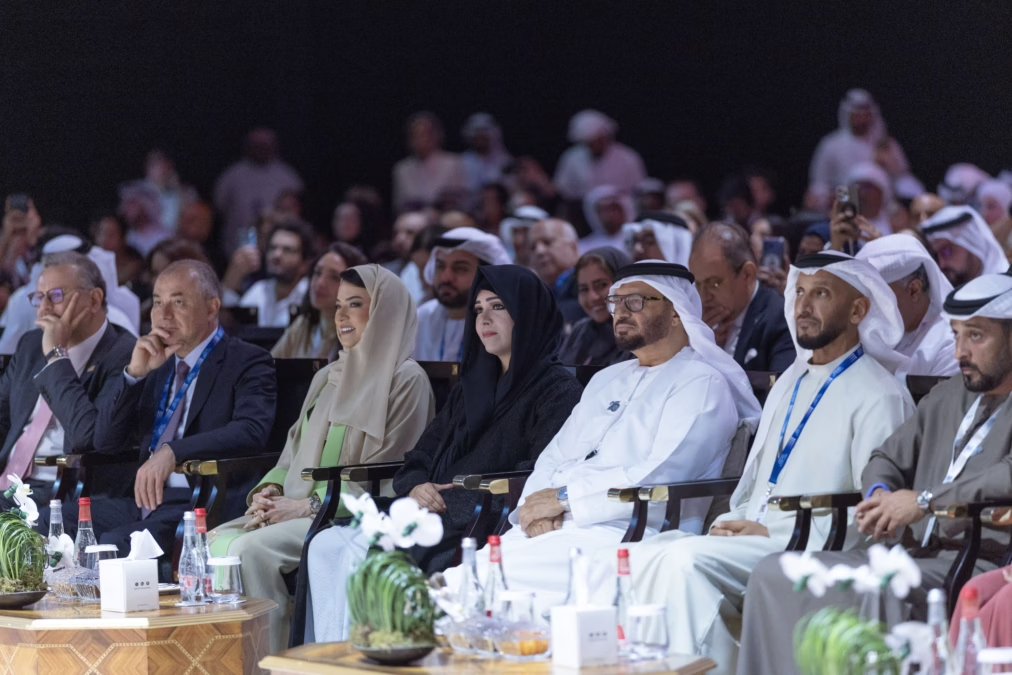
The Dubai Media Council announced this week the 15th edition of the Dubai International Film Festival. It will open on December 8th, 2027. For Dubai’s creative community, the reaction was not polite applause. It was something considerably more visceral.
“Do you know when you watch a film and it is like a massive plot twist?” said Emirati filmmaker Nayla Al Khaja, one of the first voices to publicly respond. “It felt like a plot twist when they announced DIFF. I think all of us filmmakers were shocked. But what is even more exciting is that it ignited this old fire inside us.” She had already started making calls to fellow filmmakers about what they could create in time for the festival’s return. That is the kind of announcement this was.
What DIFF Actually Was? And Why Its Absence Left a Gap Nobody Could Fill?
The Dubai International Film Festival launched in 2004 with a vision that was quietly ambitious, to make Dubai a gateway for Arab cinema to reach the world, while simultaneously putting the city on the global film map alongside Cannes, Venice and Toronto.
Over 14 editions, it delivered on that vision in ways that went far beyond red carpets and screening schedules. Its Enjaaz fund supported post-production on films that went on to become landmarks of Arab cinema, including Omar and Wadjda. Its Dubai Film Connection offered grants that gave Arab filmmakers actual resources to complete projects. International productions like Mission: Impossible Ghost Protocol premiered at DIFF, drawing global attention to Dubai as a genuine filmmaking destination rather than simply a backdrop.
For Emirati filmmaker Majid Al Ansari, the difference between having DIFF and not having it was the difference between his two most significant films. His thriller Zinzana screened at DIFF in 2015 and had a homecoming, a moment where the film returned to the community that shaped the filmmaker who made it. His later horror film Hoba, released internationally as The Vile, found success abroad without ever having that same moment.
“With Zinzana, DIFF gave us a place to bring the film home and share it with other filmmakers, colleagues, people you admire and people you have worked with,” he said. “I really missed having that with Hoba.” He described DIFF as something close to glue for Emirati cinema, the annual gathering that brought voices together, created an exchange of ideas and gave local filmmakers a stage at home to match the stages they were building internationally.
What the 15th Edition Is Actually Trying to Do?
Her Excellency Mona Ghanem Al Marri, Vice Chairperson and Managing Director of the Dubai Media Council, was deliberate in how she framed the return. This is not a revival of what existed before. It is a new chapter built on the foundation of what came before. The 15th edition will celebrate Middle Eastern cinema and talent. Moreover, it will highlight regional stories and voices and connect the Arab film industry from the inside out. Ultimately, it aims to provide a platform that connects the Arab film industry from the inside out, not import prestige.
Al Marri described the festival’s ambition as extending well beyond screenings. The goal is to build an industry platform, one that connects filmmakers with producers, talent with investors and ideas with markets. A place where partnerships form, projects begin and the region’s creative economy grows in ways that outlast any single edition.
Hesham Sultan Al Olama, CEO of the Dubai Films and Games Commission, echoed that framing, describing the festival as a mechanism for creating momentum that strengthens the international reach of regional cinema rather than simply celebrating what already exists.
December 2027 Feels Like More Than a Date
Emirati actor Mohamed F Mostafa, whose career has taken him from early DIFF screenings to Hijack alongside Idris Elba and the forthcoming Dune: Part Three, articulated the emotional weight of the announcement with characteristic precision. “As Emiratis, for many years we have felt a responsibility to take our talent and our potential to the global stage,” he said. “What is exciting about DIFF coming back is that the global stage is now coming back to us as well.”
That shift from Dubai’s creatives going out to find their global moment, to the global moment arriving in Dubai, is the most significant thing the festival’s return represents. Not a nostalgic recreation of 2004 to 2017, but a new chapter for a city that has spent the intervening decade building the creative infrastructure, the talent base and the cultural confidence to host something genuinely world-class.
Nayla Al Khaja said she hopes the 15th edition opens with a local film. Not every year necessarily, but as a statement of intent that home territory matters, that Emirati stories deserve the opening slot, that the festival returning to Dubai means Dubai returning to the festival.