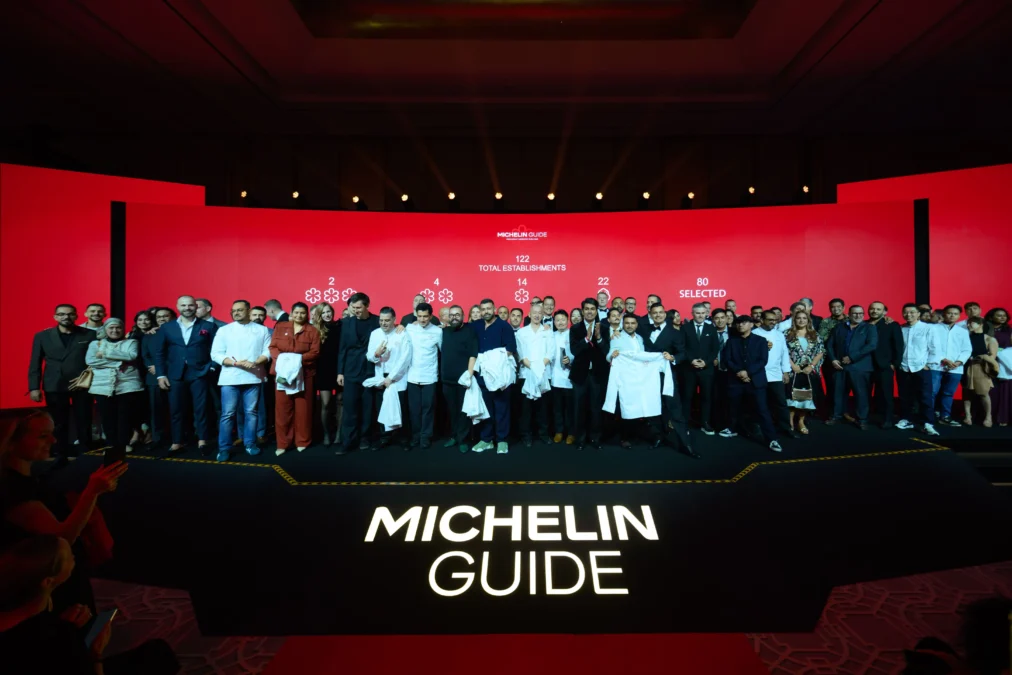
The fifth edition brings 122 restaurants across 38 cuisine types, with Orfali Bros rising to Two MICHELIN Stars and Birch and KIGO making their One-Star debuts.
There is something revealing about a city through the restaurants it chooses to celebrate.

Dubai’s dining scene has never been short of spectacle. It has the skyline, the hotel restaurants, the famous names and the tables that come with their own dress codes. But five years after the MICHELIN Guide arrived, the more interesting question is no longer whether Dubai can attract great chefs. It is what those chefs are doing once they get here. The answer, judging by the 2026 selection, is increasingly personal.
The fifth edition of the MICHELIN Guide Dubai has recognised 122 restaurants spanning 38 cuisine types, with 19 new additions to the selection. Two restaurants continue to hold the city’s highest distinction, while Orfali Bros has climbed to Two MICHELIN Stars and two newcomers, Birch and KIGO, have entered the One-Star ranks.
Taken together, the list feels less like a catalogue of expensive places to eat and more like a portrait of a city that has become considerably more comfortable with its own appetite.
Five Years, and a Very Different Dining City
When the MICHELIN Guide made its Dubai debut in 2022, the city’s restaurant scene was already crowded with international names.
Five editions later, the selection has nearly doubled in size from its first edition. More importantly, the conversation around Dubai’s food has changed. There is room now for restaurants that are not simply reproducing a familiar global formula. The 2026 selection moves between homegrown concepts, international talent, neighbourhood restaurants and highly polished fine dining, with 38 cuisine types represented across the city.
That variety is perhaps Dubai’s most interesting culinary asset.
The city does not have one obvious food identity in the way some destinations do. Instead, its character comes from the collision of many identities: Middle Eastern heritage beside Japanese precision, Indian culinary memory beside contemporary European technique, casual neighbourhood cooking alongside elaborate tasting menus.
MICHELIN International Director Gwendal Poullennec described this year’s combination of homegrown talent and international arrivals as part of a city developing its own culinary identity while embracing traditions from around the world.
That may be the clearest description of where Dubai’s restaurant story stands today.
The Two Tables Still at the Top
At the highest level, there is no change.
FZN by Björn Frantzén and Trèsind Studio have both retained their Three MICHELIN Stars, the Guide’s highest distinction.
FZN, the Dubai restaurant from Swedish chef Björn Frantzén, continues to occupy that rarefied space where precision and luxury are expected rather than announced.
Trèsind Studio, meanwhile, has become one of the most significant names in Dubai’s modern Indian dining conversation. Chef Himanshu Saini’s cooking takes Indian flavours, memories and techniques into a highly contemporary tasting-menu format, giving the restaurant a point of view that feels firmly its own.
Keeping three stars is difficult enough. Keeping them while the surrounding dining scene becomes more competitive is another achievement altogether.
Orfali Bros Moves Up
If there was one promotion in this year’s selection that was always going to attract attention, it was Orfali Bros.
The Dubai-born restaurant founded by Syrian brothers Wassim, Omar and Mohammad Orfali has moved from One to Two MICHELIN Stars, two years after receiving its first.
The significance is not simply the speed of the promotion.
Orfali Bros has built its reputation around food that carries the brothers’ own history with it. Aleppian, Armenian and Turkish influences meet contemporary technique, with the restaurant’s menus reflecting their travels and experiences rather than attempting to fit neatly into one category.
That makes the promotion feel particularly relevant to Dubai’s larger food story. The restaurant is not successful because it imitates a foreign idea of fine dining. It has taken heritage, memory and personal experience and turned them into something that belongs to Dubai. At Two Stars, it now joins Il Ristorante-Niko Romito, Row on 45 and STAY by Yannick Alléno, all of which retained their distinctions for 2026.
Two New Stars Enter the Room
The newest names in the One-Star conversation are Birch and KIGO, each arriving with a very different culinary language.
At Birch, chef Arslan Berdiev’s Turkmen roots and travels inform a contemporary menu centred on high-quality produce. Even the room itself contributes to the experience, with an open kitchen and a hanging installation inspired by birch bark.
KIGO takes another route.
Its guests can choose between a Sushi Omakase experience at the counter and a Kaiseki menu at the table, both built around seasonal Japanese cooking and carefully handled produce. The approach is restrained, detailed and deliberately theatrical without becoming excessive.
Their arrival takes Dubai’s One-Star selection to 14 restaurants.
Good Food Does Not Always Need a White Tablecloth
One of the most useful parts of the MICHELIN Guide is also one of the easiest to overlook.
The Bib Gourmand category is about good food at good value, and Dubai now has 22 restaurants carrying the distinction. Four joined the category this year: Middle Child, S.E.A Bistrot, Three Bros and YUBI Dubai. That matters because Dubai’s food culture cannot be measured only by its tasting menus.
Middle Child brings Italian cooking into a relaxed bistro-and-deli setting. S.E.A Bistrot leans into bold Asian flavours. Three Bros takes the Orfali brothers’ story into a brighter, more casual setting, while YUBI Dubai serves hand rolls across the counter in a more relaxed Japanese format.
Together, they point to a dining city where a memorable meal does not necessarily require a grand occasion.
The People Behind the Plate
A restaurant’s reputation may begin with its food, but the MICHELIN experience has always depended on more than what arrives on the table.
This year’s Special Awards put some of those less visible contributions in the spotlight.
Window at Alserkal received the Opening of the Year Award for Gonzalo Platero’s wood-fired cooking. Ninad Jani of avatāra received the Sommelier Award, while Akinori Tanigawa and the KIGO team were recognised for service. Rémy Marquignon of Ossiano took the Young Chef Award, and Zahra Erfanian Azmoodeh of Carbone Dubai received the Exceptional Cocktails Award. It is a useful reminder that a restaurant’s identity is rarely the work of one person.
The chef may write the menu, but the sommelier, bartender, service team and everyone working behind the scenes determine how that menu is ultimately experienced.
Dubai’s Food Story Is Getting More Personal
The most interesting thing about the MICHELIN Guide Dubai 2026 may not be the number of stars. It is the range of stories sitting underneath them.
There are chefs bringing family histories to the table. There are restaurants interpreting cuisines through a Dubai lens. There are established international names working alongside concepts that grew out of the city’s own restaurant culture. There are ambitious tasting menus, neighbourhood favourites and places where the food matters more than the occasion.
The fifth edition brings all of that into one selection: 122 restaurants, 38 cuisine types, 19 new additions, two Three-Star restaurants, four Two-Star restaurants, 14 One-Star restaurants, 22 Bib Gourmands and 80 MICHELIN Selected restaurants.
Five years in, Dubai does not seem interested in choosing between being international and being itself. Its dining scene is becoming interesting precisely because it is doing both.
And perhaps that is the real achievement behind this year’s stars. Dubai has gone from being a city where the world’s food arrived to a city increasingly capable of giving that food its own accent.