
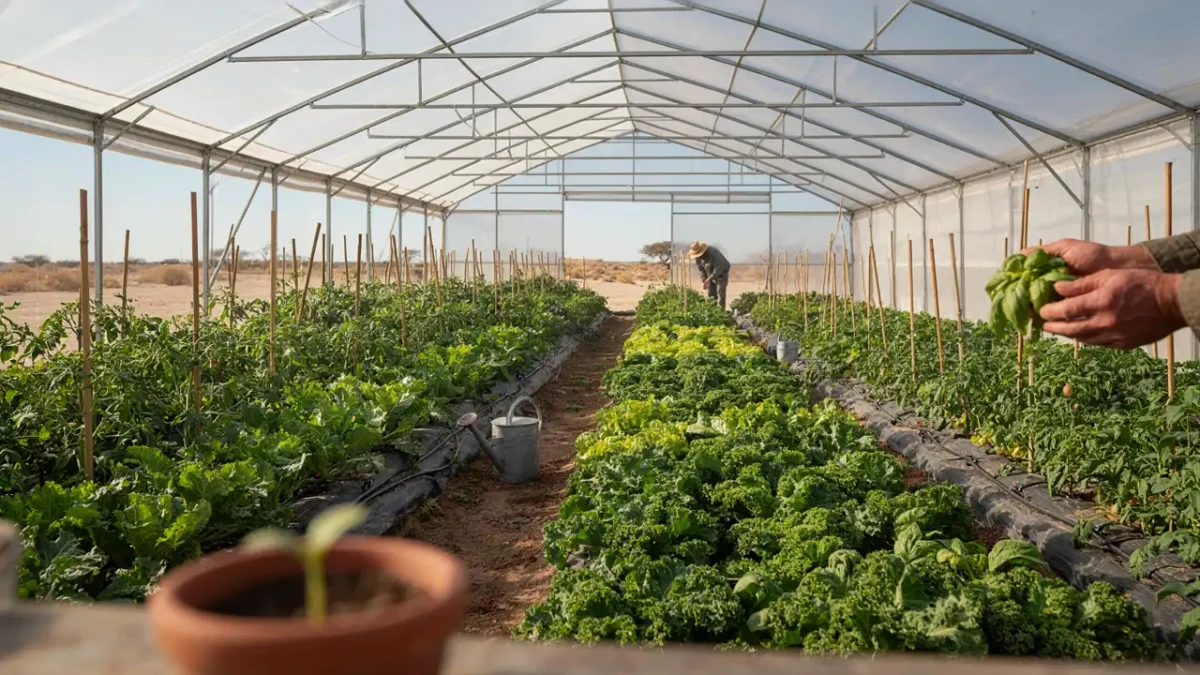
From capping salt in your bread to building Dubai’s entire food security architecture from scratch, the UAE’s food health agenda has never been more deliberate or more comprehensive.
Here is a number that should give anyone pause. A National Health and Nutrition Survey found that 96.2 percent of UAE residents consume sodium well above recommended daily limits. Not a small percentage. Not a concerning minority. Nearly every single person in the country is eating more salt than their body is designed to handle on a long-term basis.

That statistic landed in a government office somewhere, someone decided it was unacceptable, and what followed has been one of the most quietly comprehensive overhauls of food policy in the region.
The Dubai Food Security Strategy 2030, announced this week by the Dubai Environment and Climate Change Authority, is the latest piece of a picture that has been assembling itself throughout 2026 — a systematic, multi-layered effort to change not just what is available to residents but what the food system itself is built around.
What Is Actually Happening to Your Food Right Now
October 2026 has been a significant month for anyone paying attention to what arrives on UAE dinner tables.

The Ministry of Health and Prevention implemented new limits on sodium, sugar and fat in selected packaged foods, introducing phased reductions across products including bread, sweetened milk drinks, flavoured yoghurt and laban, salty snacks and processed cheese. The limits are not suggestions. Food establishments that fail to comply face administrative penalties ranging from a warning to fines of between Dh5,000 and Dh500,000.
The mechanics of the change are worth understanding. For leavened bread, sodium must fall from a first-phase cap of 444mg per 100g to 370mg in the final phase. Sugar must drop from 6g to 5g and fat from 8.4g to 7g per 100g, according to Gulf News. These are not dramatic single-day shifts. They are phased reductions running to December 31, 2030, giving manufacturers time to reformulate rather than requiring overnight compliance. The final result will be food that looks identical on the shelf but carries meaningfully different nutritional content.
Related Stories

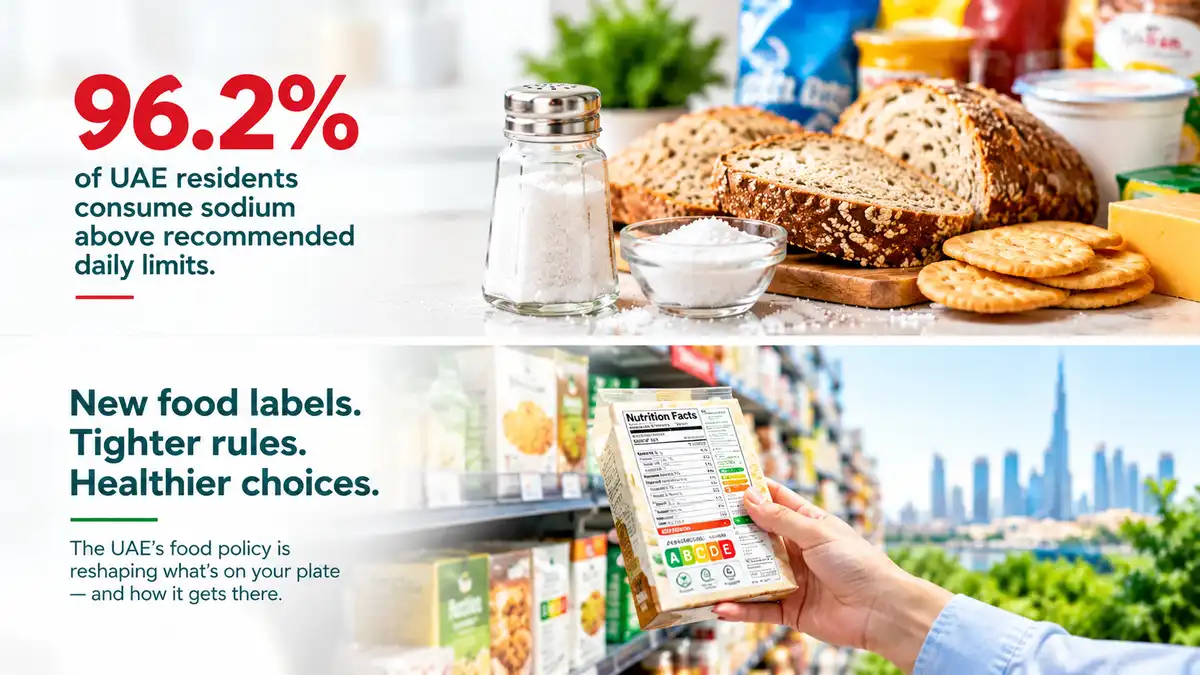
The health drive ranges from new food labels through the Nutri-Mark system to tighter advertising rules, changes in supermarket layouts, expanded community fitness programmes and stronger nutrition standards in schools and workplaces. From January 1 next year, supermarkets larger than 4,000 square feet in Abu Dhabi will no longer be allowed to place foods and drinks high in fat, salt or sugar in prominent areas such as entrances, checkouts and the ends of aisles.
That last measure is particularly significant because it operates on something most consumers never consciously examine: the architecture of temptation. Where food is placed in a supermarket determines what people buy far more reliably than what they intend to buy when they walk through the door. Removing high-sugar, high-fat products from the positions that generate impulse purchases is an intervention that does not require the customer to make any conscious decision at all.
Enter Dubai Food Security Strategy 2030
Against that backdrop of active nutritional reform, the Dubai Environment and Climate Change Authority this week unveiled the Dubai Food Security Strategy 2030, approved by His Highness Sheikh Hamdan bin Mohammed bin Rashid Al Maktoum, Crown Prince of Dubai and Chairman of the Executive Council.
Related Stories

The strategy is built around five pillars: food availability, affordability, quality and safety, sustainability and resilience, and industry empowerment. These are not abstract categories. Each carries a specific set of initiatives with defined objectives.
The first initiative focuses on sustainable local agricultural production — expanding fisheries, developing the livestock sector and building cooperative structures for small-scale farmers. The second strengthens food supply chains to make them more resilient and responsive, with particular emphasis on diversifying import sources and building strategic partnerships for essential commodities. The third directly addresses consumption behaviour, aiming to reduce food waste and educate residents about healthier and more sustainable dietary choices. The fourth focuses on governance, regulation and the investment framework for the food sector, including enhanced tools for AgriTech investors. The fifth builds the broader food ecosystem infrastructure needed to absorb market fluctuations without disrupting supply.
His Excellency Ahmed Mohammed bin Thani, Director General of DECCA, described the overarching ambition as positioning Dubai as a global leader in sustainable food security. “This strategy will contribute to boosting local production, reducing food waste, and ensuring the availability and affordability of healthy food,” he said.
Obesity Is the Underlying Story
Food security in the UAE is not primarily a scarcity problem. The country imports around 80 percent of its food and has the infrastructure to do so reliably. The food security challenge here is different: it is about the quality of what is available, the affordability of healthier options and the accumulated health consequences of a population eating food that has been optimised for palatability rather than nutrition.
Health experts told, that the UAE’s new limits on salt, sugar and fat in packaged foods represent an important shift towards changing the food environment itself, rather than placing the responsibility for healthier eating entirely on consumers. That distinction is critical. Campaigns that tell people to eat better without changing what is available to them have a well-documented record of limited effectiveness. Campaigns that change the food itself, while simultaneously changing how it is displayed, labelled, marketed and priced, operate on the system rather than the individual.
Food manufacturers have already begun responding to the wider health drive, with companies noting that the regulations are welcome and will succeed with private and public collaboration.
The Long Game
The Dubai Food Security Strategy 2030 and the Ministry of Health’s sodium, sugar and fat regulations are not the beginning of this conversation. They are the latest additions to a framework that has been building across multiple government bodies for several years.
Abu Dhabi’s Healthy Living Strategy, launched in November 2025, provides Emirati adults identified as overweight or obese with personalised health plans. A school food Red List identifies products that cannot be consumed on school premises. Children’s menus must meet approved nutritional criteria. Abu Dhabi has introduced restrictions on fast-food advertising as part of a wider campaign against obesity, diabetes and other chronic diseases.
The Global Food Security Summit held in Abu Dhabi earlier this month brought together more than 70 countries to examine food system resilience at an international level. The Tanzania-UAE Green Silk Road Initiative, launched during the summit, is building an agricultural corridor connecting production, processing, logistics and market access between Tanzania and the UAE.
What all of these initiatives share is a recognition that food is not simply a supply chain problem or a consumer choice problem. It is a public health problem, an economic problem, a sustainability problem and a governance problem simultaneously. Addressing it requires policy interventions across all of those dimensions at once.
The UAE is attempting exactly that. The Dubai Food Security Strategy 2030 is not the final announcement in this space. It is a structural commitment that will generate further initiatives, regulations and investments through the rest of the decade.
Your bread is already getting less salty. The food on your supermarket shelf is being reformulated. The produce market is being diversified. The supply chain is being strengthened.
None of it arrives with fanfare. But taken together, it adds up to one of the most comprehensive food system interventions the region has seen.