The Dubai real estate sector continues to demonstrate incredible adaptability during shifting international conditions. Regional disputes and global financial turbulence often trigger economic hesitation in major world markets. However, the emirate consistently proves its ability to turn market stress into sustained investment growth.
In the beginning of 2026, external uncertainty loomed large in the real estate market. The geopolitical tensions in Eastern Europe and the Middle East in February and March immediately caused global concerns. Investors around the world thoroughly considered international asset risk, equity markets and regional safety.
Front line fighting and military escalation have largely died down, and markets have been revived dramatically. Investors can use the property metrics of Q1 to compare with current performance indicators. Analyzing this contrast shows how the Dubai real estate geopolitical tension dynamic evolved from defensive capital placement into aggressive market expansion.
Q1 Market: Defense and Caution
During February and March, international investors navigated complex global conflicts and financial volatility. Western capital markets experienced heightened fluctuations, and oil prices fluctuated sharply. Consequently, international buyers sought safe havens for asset preservation.
Despite regional tension, transaction volumes across the emirate remained remarkably stable. Data from the Dubai Land Department recorded over eleven thousand sales transactions per month throughout February and March. Total property transaction values surpassed AED 29 billion during March alone.
In addition, high-net-worth individuals were interested in geographic diversification in prime luxury communities. Some places in the city, such as Palm Jumeirah, Emirates Hills and Downtown Dubai, maintained price floors. Foreign investors chose to invest in physical assets over the volatile global equities in a tax-efficient environment. Hence, Dubai real estate market has test strengthened itself in a global politically unstable period.
Off-Plan Demand Versus Ready Property Shift
The February-March window showed a noticeable shift toward immediate asset delivery. Buyers favored ready residential units over long-term off-plan developments during peak geopolitical tension. Investors preferred holding immediate, tangible titles in completed buildings to mitigate future construction timeline risks.
Ready property sales accounted for nearly fifty-four percent of total real estate transactions in late February. Buyers paid a premium for immediate occupancy and instant rental yields. Furthermore, cash transactions surged significantly compared to mortgage-backed purchases during Q1. High global interest rates combined with international risk aversion pushed wealthy buyers toward full cash settlements.
In contrast, off-plan launches during March experienced a brief operational pause by developers. Major builders adjusted marketing timelines to observe broader macroeconomic developments. However, overall pricing per square foot did not drop across prime residential sectors. The market absorbed geopolitical stress without experiencing price reductions or distress selling.
Current Market: Stability and Expansion
Today, frontline conflicts have quieted down and political dialogue has eased international friction. Consequently, market sentiment across the real estate sector has shifted completely into expansion mode. Consumer confidence among global investors has reached new record highs.
Recent transactional reports from Property Finder indicate a massive resurgence in off-plan real estate investment. Off-plan sales now represent over sixty-two percent of total monthly property transactions across the city. Developers have resumed mega-project launches in response to relentless international demand.
Overall transaction volumes have expanded past fourteen thousand sales contracts monthly. Monthly transaction values currently exceed thirty-eight billion dirhams, marking a significant increase over Q1 numbers. Furthermore, developer payment plans and competitive pricing structures continue to attract middle-income expatriates alongside ultra-wealthy investors.
Rental Yields and Capital Growth Trajectory
The contrast between Q1 caution and present market growth shows clearly in total property yields. During February and March, rental yields remained healthy at six to seven percent gross returns. However, elevated tenant demand driven by population growth has since pushed average rental yields higher.
Current market data reveals average residential gross yields ranging between seven and nine percent across popular mid-market communities. Certain areas in Dubai such as Jumeirah Village Circle, Dubai Silicon Oasis, and Dubai Hills Estate offer outstanding returns to property owners. Residential capital appreciation has also risen 12% year-to-date, on average, throughout prime communities.
In addition, census data corroborate this trend of long-term growth. The city gained more than half a million people in the first half of the year. Businessmen, professionals, executives from outside the country keep coming to the emirate with a plan to stay. As a result of this “inflow,” there is a steady demand that the property owner can offset with lower prices in the long-term rental market, allowing the property owner to shield themselves from lower prices.
Comparing Key Performance Indicators
A direct statistical comparison between early 2026 tension and present market stability highlights this rapid upward trend. Analyzing transactional data confirms that temporary geopolitical friction did not disrupt long-term market momentum.
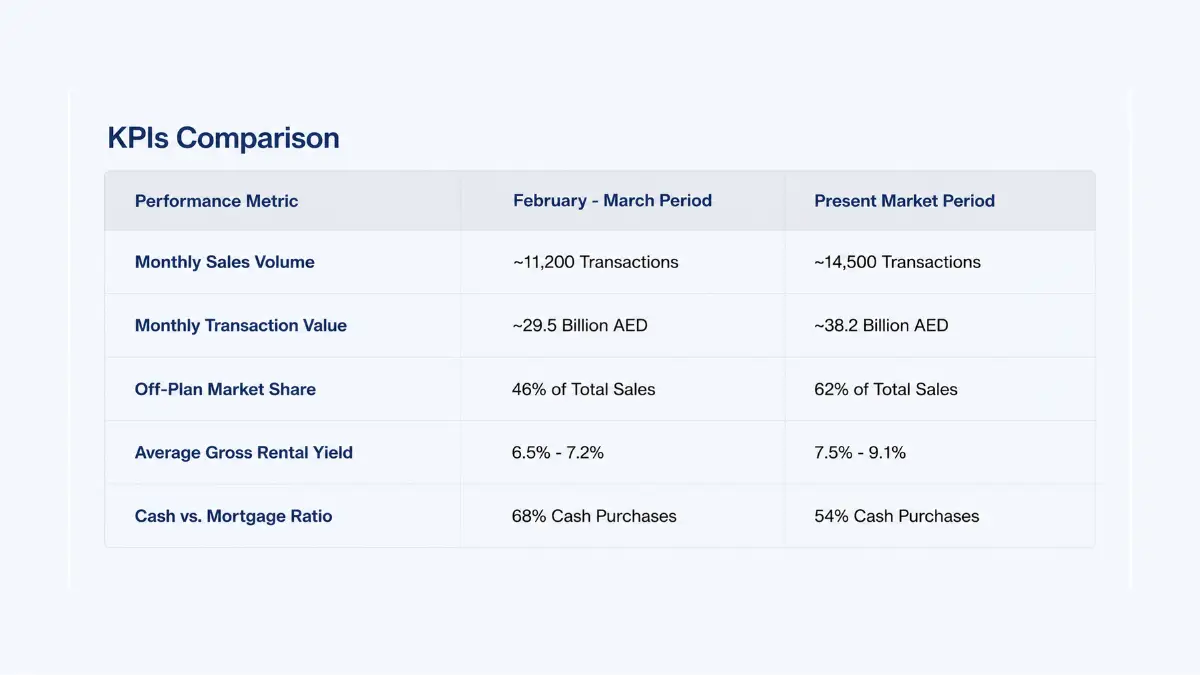
The shift from cash-heavy, ready-property purchases during Q1 to widespread off-plan investment today reflects rising economic confidence. Mortgage transactions have also rebounded as international central banks ease monetary policies. Overall, capital inflow has expanded beyond regional safety seeking into long-term strategic wealth building.
Dubai Real Estate Outlook Going Forward
Navigating real estate options through periods of global tension requires a clear understanding of market fundamentals. The emirate has successfully positioned itself as an insulated financial hub capable of weathering global political disputes. Furthermore, strong regulatory frameworks enforced by real estate authorities protect foreign buyer funds through secure escrow systems.
Looking ahead, the market shows zero signs of slowing down. Sustainable population growth, favorable visa policies, and strong economic diversification continue to drive real estate absorption. Investors who bought property during the uncertain months of February and March have already gained significant capital appreciation.
Ultimately, analyzing Dubai real estate geopolitical tension metrics proves the structural resilience of the local market. The shift from cautious capital preservation in Q1 to aggressive market expansion today demonstrates unshakeable global buyer confidence. Whether during times of international tension or periods of total stability, the real estate market remains a top destination for global wealth.
Read More: Dubai Property Investment Tips: Essential For Dubai Real Estate