
Renewal season is here, rents are softening in ways they have not in years, and a seasoned broker just told us exactly how to use that to your advantage.
Let us set the scene. Your lease renewal notice just landed. The number your landlord is proposing sits at the top of the page, bold and unapologetic. Two years ago you would have signed immediately, grateful the increase was not worse. Last year you negotiated cautiously, hoping for the best. This October, for the first time in a very long time, you might actually be holding the stronger hand. Dubai’s rental market has shifted. Not collapsed, not crashed, not done anything dramatic enough to make international headlines. But shifted, quietly and meaningfully, in ways that matter enormously to anyone who calls this city home and pays rent to do so.

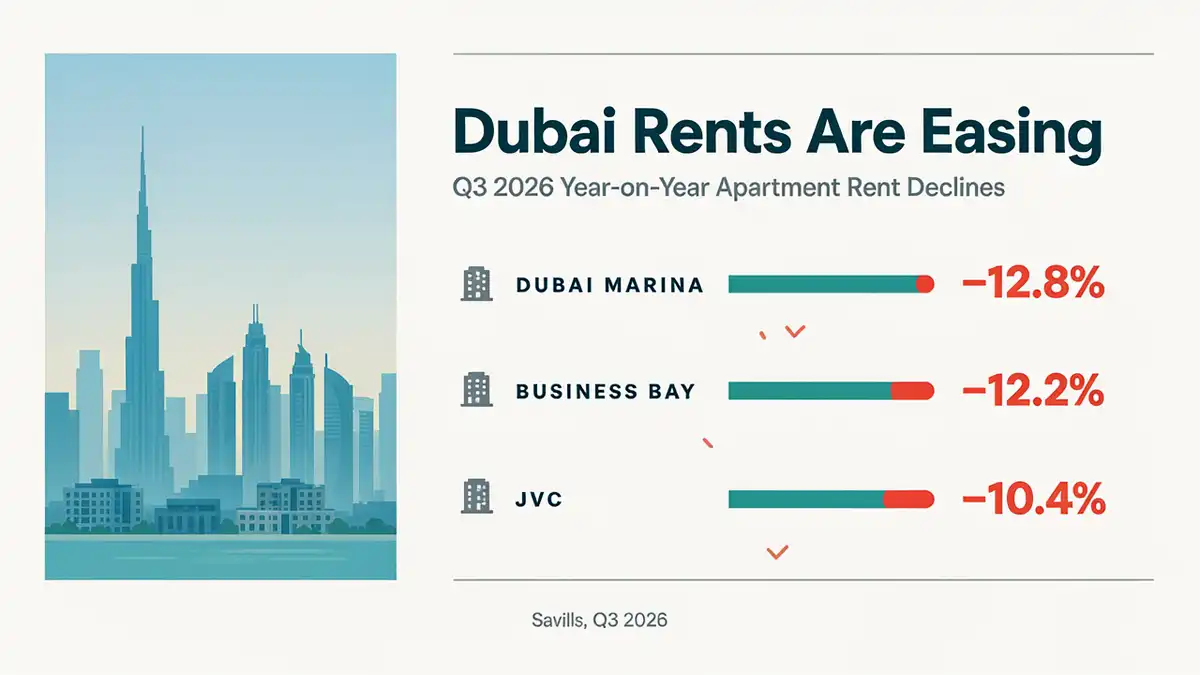
Apartment rents in Dubai Marina, Business Bay and Jumeirah Village Circle fell 12.8 percent, 12.2 percent and 10.4 percent year on year respectively during the third quarter of 2026, according to property consultancy Savills’ Q3 2026 report. Those are not rounding errors. Those are double-digit drops in three of the most popular residential communities in the emirate, arriving just as October’s renewal season kicks into gear.
Median rents in Business Bay fell from approximately Dh105,000 to Dh85,000 according to Gulf News, improving affordability for tenants and supporting faster occupancy for landlords. That is Dh20,000 back in a tenant’s pocket annually on a single apartment.
But raw numbers only tell part of the story. The rest requires someone who has been watching this market from the inside.

The Broker Who Called It Early
Manauar Ali Khan, CEO of Home Seven Real Estate, has been navigating Dubai’s real estate cycles long enough to know the difference between a statistical blip and a genuine market turn.
His assessment of where things stand right now is refreshingly straightforward.

“We are seeing more flexibility in parts of Dubai’s rental market,” he says. “Areas such as Business Bay, Dubai Marina, Downtown Dubai and JVC are showing more competitive asking rents compared with last year. However, it depends on the building, property condition, location and landlord’s expectations. Well-maintained properties in prime locations can still attract strong interest.”
Then he says something that cuts through the noise of competing headlines and contradictory forecasts: I see this as a healthier market where tenants have more options and landlords need to price their properties realistically.”
A healthier market. Not a tenant’s market by declaration, not a landlord’s loss by design. A recalibration, where the rules of engagement have shifted enough that both sides need to think differently.
Home Seven Real Estate has been closely tracking rental movements across key Dubai communities, and Khan’s read on the market this season carries the weight of someone watching transactions happen in real time, not just reading about them.
Related Stories

The Numbers Behind the Shift
To understand why this moment feels different, it helps to remember where Dubai’s rental market has been.
After two consecutive years of aggressive double-digit rent growth, the market shifted into a healthier single-digit pace in 2026, according to real estate consultancy reports. For tenants who lived through 2023 and 2024, those years felt like trying to hold on while the floor kept rising—renewals came with increases that felt less like negotiations and more like ultimatums. Accept the increase, relocate somewhere cheaper, or find a way to absorb a cost that kept climbing regardless of your personal circumstances.
That cycle has broken.
Downtown Dubai saw the steepest correction, with median asking rents dropping from approximately Dh230,000 to Dh180,000. Dubai Marina fell from Dh155,000 to Dh130,000. Business Bay came down from Dh120,000 to Dh105,000. JVC moved from around Dh80,000 to Dh72,000. Dubai Hills Estate was the only community tracked that held flat.
These are advertised asking rents, which means actual signed prices typically settle lower still after negotiation. The gap between what landlords list and what tenants ultimately pay has widened considerably, and that gap is exactly where a prepared tenant operates most effectively.
Meanwhile, the share of new leases climbed to 44 percent of total activity in Q3, up from 36 percent in Q2, according to Savills, driven by stronger leasing momentum in Business Bay, JVC, Jumeirah Village Triangle and Downtown Dubai. When more tenants are signing fresh contracts rather than simply renewing existing ones, it signals that landlords who lose a tenant are no longer guaranteed to replace them quickly at the same price.
Because asking prices reflect a landlord’s listed ambition rather than the final signed deal, the growing gap between listing prices and closed contracts is precisely where a well-prepared tenant can operate. Landlords who lose a tenant are no longer guaranteed an immediate replacement at the same rate, giving tenants genuine room to negotiate.
Can You Actually Ask for 10 Percent Off?
This is the question every tenant wants answered and almost nobody asks out loud.
Manauar Ali Khan speaks with the kind of measured confidence that only comes from years of watching this market up close.
It can work, but it is not guaranteed,” he says. “A 10% reduction is a reasonable starting point for a discussion if similar properties in the same building or community are being advertised at lower rates.”
He then lays out exactly what makes the difference between a negotiation that lands and one that goes nowhere.
The strongest approach is to support the request with comparable listings, a good rental history and a willingness to renew for another year. In some cases, landlords may agree to a reduction; in others, they may offer more flexible payment terms or other benefits instead.”
The practical checklist before you walk into that conversation:
First, pull three to five current listings in your building or immediate community. Not from six months ago. From this week. Portals like Property Finder, Bayut and DXB Interact are updated regularly and give you a defensible number rather than a feeling.
Second, check the RERA Rental Index at the Dubai Land Department’s official portal or through Dubai REST. This tells you the legally permitted range for your specific property. If your current rent already sits at the top of that range, your leverage is limited. If it sits above it, your landlord has already been technically overcharging and your position is considerably stronger.
Third, put everything in writing from the start. WhatsApp counts. Email is better. The moment a landlord confirms anything verbally, follow it immediately with a written summary. “As discussed, you mentioned flexibility around Dh X” creates a record that a purely verbal exchange does not.
Fourth, start early. The biggest mistake, Manauar Ali Khan says with considerable clarity, is waiting until the last minute.
The biggest mistake is waiting until the last minute and negotiating without checking current market rates. Tenants should start the conversation early, compare similar properties and understand the applicable RERA rental rules.”
Early means at least 60 to 90 days before renewal, not two weeks before the current lease expires.

JVC, Business Bay or Sharjah: Where Does Your Money Go Furthest?
This is the question that keeps group chats going at 11pm and salary discussions running long. And the answer, frustratingly but honestly, depends on what you are actually optimising for.
Manauar Ali Khan ranks them directly, and his reasoning is worth sitting with.
“JVC offers a good balance of relatively affordable rents, modern apartments and community facilities,” he says. “Business Bay is a strong option for professionals working in central Dubai who value being close to offices, restaurants and public transport, although rents can be higher. Sharjah remains attractive for people looking to reduce housing costs, particularly those who are comfortable with the commute into Dubai.”
His final ranking: “For many young professionals, I would put JVC first for the balance between lifestyle and convenience. Sharjah is worth considering for budget-conscious renters, while Business Bay suits those who prioritise location.”
Current typical annual rent ranges give useful context. JVC sits at Dh60,000 to Dh95,000 for a one-bedroom apartment. Business Bay ranges from Dh95,000 to Dh145,000. Dubai Marina runs from Dh100,000 to Dh150,000 and Downtown from Dh130,000 to Dh190,000. The JVC to Business Bay gap on a one-bedroom, at its widest, could be Dh85,000 annually. That is more than Dh7,000 per month. For someone on a young professional salary, that is not a lifestyle choice. It is a financial decision that compounds significantly over two or three years.
Sharjah deserves its own honest treatment. The commute into central Dubai during peak hours can run 45 minutes to over an hour in each direction. For a hybrid worker doing three days a week in the office, that calculation is very different than for someone commuting daily. The rent saving can be substantial, but the time cost is real and the quality-of-life consideration is personal.
Who Is Actually Winning This Season?
Here is where the conversation gets more interesting than the headlines usually allow.
Manauar Ali Khan resists the framing of winners and losers entirely, and he is right to do so.
At the moment, tenants appear to have more negotiating power in several Dubai communities because they have more properties to choose from. But I would not say landlords are losing across the board.”
He continues: For landlords, realistic pricing, good property maintenance and responding quickly to prospective tenants are becoming increasingly important. For tenants, this is a good opportunity to compare options and negotiate a fair deal. Ultimately, the market is becoming more balanced, which is positive for both sides in the long run.”
That word, balanced, keeps surfacing in serious conversations about Dubai’s rental market this season. It is not the dramatic narrative that gets clicks. But it is the honest one.
Average apartment rents from December 2020 to May 2026 had grown by around 94 percent, and average villa rents by around 102 percent. The market has been running hot for four years. A period of balance, where supply is catching up, landlords are competing for good tenants and new leases are increasing as a share of total activity, is not a crash. It is a correction toward something more sustainable.
For tenants, that correction is an opportunity. But only for those who prepare for it rather than stumble into it.
One More Thing to Watch
Dubai’s Flexi Rent initiative is expected to change tenant behaviour by reducing the pressure of large upfront payments. The ability to pay monthly rather than in two or four cheques annually is a meaningful shift for households managing cash flow, and as more landlords accept it, the decision between renewing and relocating changes character slightly. A manageable monthly payment in a slightly more expensive area can sometimes make more practical sense than a large upfront payment in a cheaper one.
The Dubai rental market has never been more navigable for a tenant who does their homework. The data exists. The tools exist. The market conditions exist.
Whether you use them is entirely up to you.