
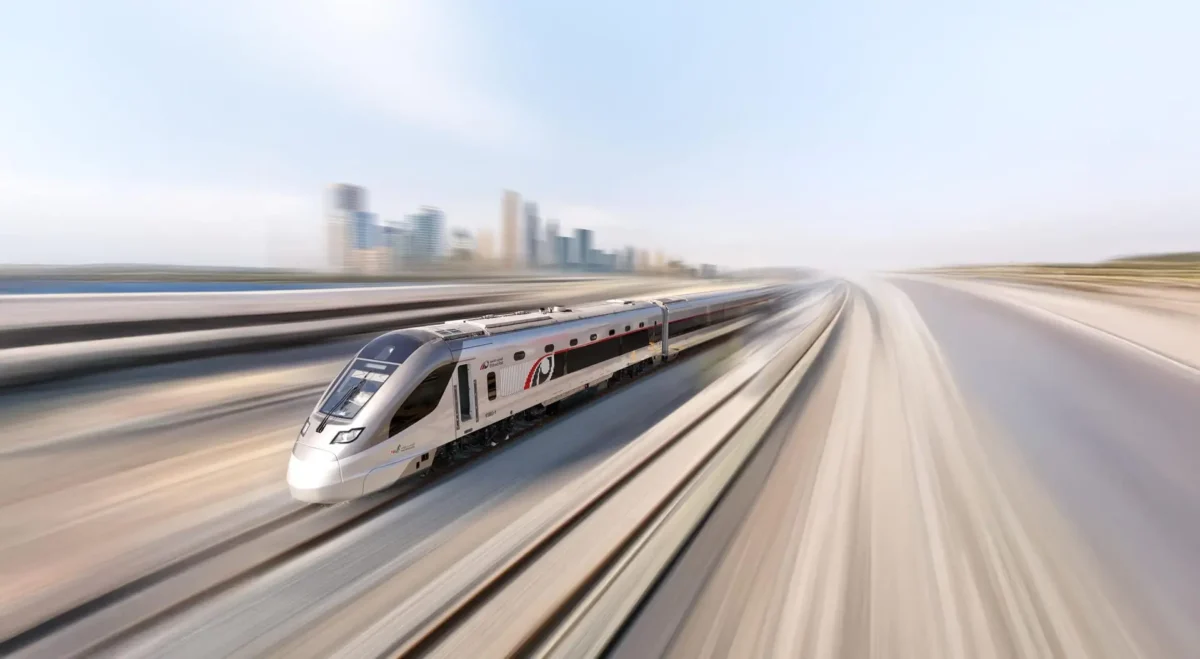
Etihad Rail’s Dubai-Abu Dhabi passenger service launches September 30th. The commuters who make this journey most often have already done the maths, and the car is losing.
There is a particular kind of exhaustion that only regular Dubai-Abu Dhabi commuters understand. It is not just the time. It is the accumulated weight of thousands of small decisions which lane to merge into, when to stop for petrol, whether the Salik bill this month is going to be embarrassing all adding up to a journey that arrives before you do, mentally speaking.
Related Stories

From September 30th, there is another option. Etihad Rail’s new passenger service connects Dubai Al Yalayis Station near Jumeirah Golf Estates to Mohammed Bin Zayed City in Abu Dhabi in approximately 57 minutes. Free Wi-Fi included. No Salik. No petrol. No lane anxiety.
The question is whether the people who make this trip most often will actually leave the car behind.
The Commuters Have Already Done the Maths
Akshata Kamath is a media professional who lives in Abu Dhabi and commutes to Dubai Media City almost every day. She has calculated the train’s value precisely and it comes down to something more than time.
“On a train, you don’t really feel the length of the journey,” she says. “With free Wi-Fi, you can easily respond to emails and catch up on work before heading to the office.” She lives ten minutes from the Abu Dhabi station in MBZ City, the Dubai station connects directly to the Metro, and the fare starts at Dh39 for a single trip, cheaper than a taxi, considerably faster than a bus.
She would not necessarily take it every day. But a few times a month? Without hesitation.
Shreya Parthasarathy, a consultant who crosses between the two emirates once or twice weekly, frames the calculation differently. She acknowledges the last-mile consideration getting to and from stations adds tim, but concludes the overall equation still favours the train. “Even after factoring in those last-mile considerations, I think it is worth trying. It could be a convenient option for a lot of commuters.”
Ahmed ElMowalad, a Dubai-based tech professional who previously made the Abu Dhabi trip every few weeks, points to the hidden costs that drivers rarely add up properly. “When you factor in Salik and petrol costs, the train could be a convenient alternative.” He also makes a point that goes beyond personal convenience, teams travelling together for meetings save hours of collective productivity by taking a 57-minute train rather than spending the same time fragmented across multiple cars in peak-hour traffic.
The Environmental Argument Nobody Is Talking About Loudly Enough
Here is the angle that rarely makes it into commuter conversations but probably should.
The Abu Dhabi-Dubai corridor is one of the most heavily trafficked inter-city routes in the region. Thousands of vehicles make that journey every single day private cars, taxis, rideshares, buses, each one burning fuel, generating emissions and adding to a congestion problem that compounds itself the more people try to solve it individually by leaving earlier or taking alternate routes.
A single Etihad Rail train carrying hundreds of passengers removes an equivalent number of private vehicles from that corridor. At scale if even a fraction of regular commuters shift their journeys to rail the reduction in carbon emissions across that route becomes genuinely significant. The UAE has committed to net-zero by 2050 and Etihad Rail has positioned its network explicitly as part of that sustainability story. Choosing the train is not just a personal convenience decision. It is, in a small but cumulative way, an environmental one.
Rasha Abushamaa, a marketing specialist and mother of four who spent three years commuting daily between the two emirates, puts it simply. “I think when you’re on a train, you don’t really feel the length of the journey as much, and you can use the time to work on your laptop or read a book.” She is already planning a family train trip to Fujairah, tourism by rail rather than a four-wheel convoy, the kind of behavioural shift that multiplies quietly across populations before anyone formally decides it has happened.
Not Everyone Is Convinced Yet — and That Is Fine
Benny Huang is 21, recently licensed and currently more interested in driving than riding. He represents a very real demographic people for whom car ownership is still new, still exciting and still the default. He might drive to the station, leave the car and take the train just to see. That is not a rejection of rail. That is exactly how new transport habits form.
The wait-and-see crowd is not an obstacle to Etihad Rail’s success. It is its next wave of passengers.
What This Means for the Job Market?
James Randall, Middle East Sales Director at HireRight, articulates the wider implication clearly. Faster, more predictable inter-emirate travel changes the radius within which job opportunities feel realistic. A role in Abu Dhabi that once felt impractical for a Dubai resident or vice versa becomes viable when the commute drops from two hours to under one.
“Easier travel between Dubai and Abu Dhabi could make roles that candidates previously considered impractical feel genuinely viable, particularly where employers offer hybrid working,” Randall says. “A reliable passenger rail link could also help employers recruit from a broader talent pool, while giving workers more choice without requiring them to relocate.”
He is careful to note that transport is one factor among many, salary, flexibility and career progression still drive decisions. But connectivity shapes the size of the playing field those decisions are made on. A broader talent pool benefits employers. More viable opportunities benefit workers. The train benefits both.
September 30th Is One Week Away
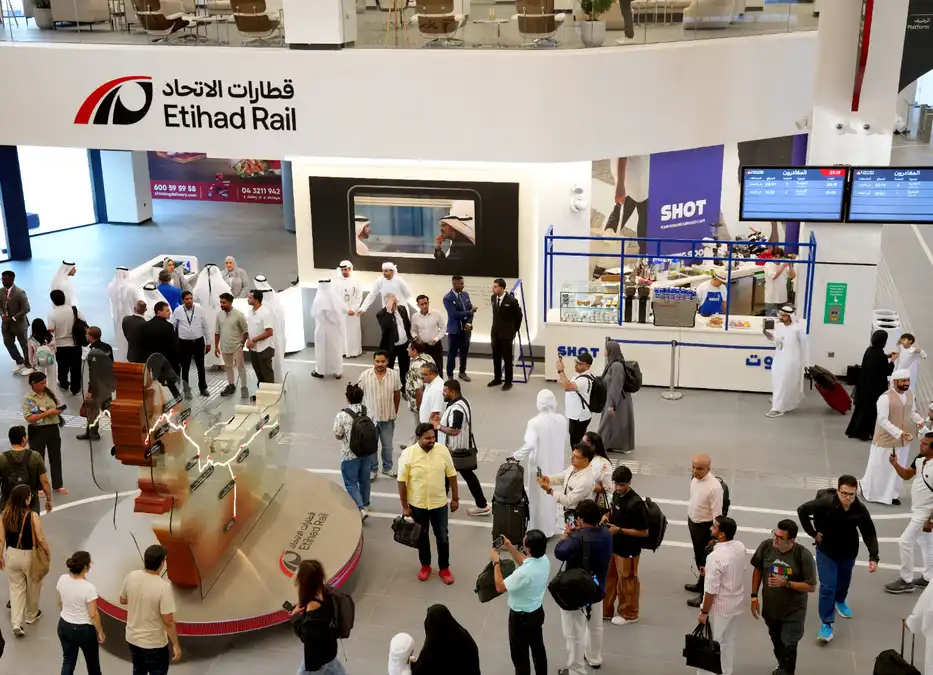
The station opens next Tuesday. The journey takes 57 minutes. The fare starts at Dh39. The Wi-Fi is free. The carbon footprint is a fraction of the equivalent car journey.
Dubai’s relationship with its car is long, complicated and not about to end overnight. But the commuters who have already done the maths the ones spending two hours each way in traffic, watching their mornings evaporate on Sheikh Zayed Road, are ready for something different.
The train is ready too.