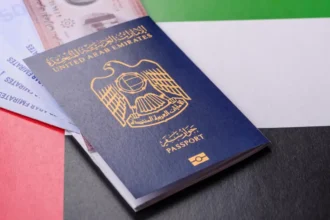

On June 25th 2026, the UAE rose to a new dawn with a longer welcome list. The UAE visa on arrival programme was extended. It now includes nationals of the Socialist Republic of Vietnam, the Kingdom of Thailand, the Republic of South Africa, the Republic of Kenya, the Republic of the Philippines, and the Republic of Indonesia.
It was issued concurrently by the Ministry of Foreign Affairs and Federal Authority for Identity, Citizenship, Customs and Port Security. So, it’s now even easier for millions of workers who travel internationally for work in these six countries to make their trip to the UAE more meaningful.
Related Stories

How Does UAE Visa on Arrival Operate?
UAE visa on arrival is not a complete visa free regime. A particular way of obtaining residence for citizens of certain countries already residing in another country has been approved.
The reasoning behind this is simple. If some big country, like the United States, the United Kingdom or Japan, has already gone through enough of a vetting process to grant you legal residency, the UAE is ready to do the same. It allow you to get a UAE visa on the spot, as opposed to weeks beforehand.
Eligible travellers from the six new countries can to apply for a 14-day and/or 60-day UAE visa on arrival. It also depends on their country of origin. A valid residence permit from the United States, or a member of the European Union is also eligibility criteria. Residence permit from the United Kingdom, Singapore, Japan, South Korea, Australia, New Zealand or Canada is also eligible.
The fees are clearly stated. The total issuance fee for 14 Days visa is AED 100 . The total issuance fee for 60 Days visa is AED 250. Visas may be extended once, during the visitors’ stay in the UAE for 14 days.
The 60 day visa will be issued as a single visa, and cannot be renewed. Meanwhile, overstay fine is at AED 50 per day with no grace period. And the passport has to be valid for at least 6 months from the date of arrival.
Who Was Eligible Before and What Just Changed
Previously, only Indian nationals were eligible for the UAE visa on arrival category, that is, nationals of a country holding a residence permit from an approved developed nation. The latest update also expanded the list of qualifying residence-permit countries. It now added Singapore, Japan, South Korea, Australia, New Zealand, and Canada to the list already in place.
That change matters as much as the six new nationalities. A Filipino nurse living in Canada, an Indonesian engineer based in Singapore, or a South African professional residing in Japan can now fly to the UAE without arranging a pre-trip visa.
That removes a step that has historically required days or weeks of paperwork, which for short visits or business trips can be the difference between going and not going.
Why These Six Countries Specifically?
The selection is not random. It reflects where the UAE’s economic, diplomatic, and human ties are deepest and most active. The Philippines’ Department of Foreign Affairs welcomed the move for its citizens.
The UAE visa on arrival decision for Filipino nationals symbolises the excellent bilateral relations between the Philippines and the UAE, the department said. The UAE has one of the world’s largest overseas Filipino communities, with an estimated 660,000 Filipinos living and working across the country.
Indonesia, the world’s most populous Muslim-majority country, is an important trading partner of the UAE. Moreover, Thailand and Vietnam are two of the fastest growing economies in Southeast Asia, with strong flows of investment between the two countries. Kenya is the commercial center of East Africa. South Africa also has the continent’s most developed financial and industrial infrastructure.
The Ministry of Foreign Affairs said expanding the scope of eligibility reflects the UAE’s commitment to strengthening its bilateral relations with friendly countries and improving economic, cultural, and personal connections.
What UAE Visa on Arrival Means for Workers and Visitors
The practical benefits land across several categories of people. For tourists, it removes pre-departure administration entirely for qualifying travellers, allowing more spontaneous and shorter-notice visits.
A 60-day visa at AED 250 is more competitive than the usual visa processing period and costs for business travellers. The extension to accompanying family members is relevant to families as it allows a worker from overseas to join the worker without a separate visa.
The authorities hope this will increase tourist numbers, boost business travel, attract investors and skilled personnel and improve the UAE’s status as a global hub between Asia, Europe and Africa.
The expansion also aligns with the UAE’s ongoing visa reforms, such as the Golden Visa and Green Visa programs. These aim to enhance economic diversification, tourism and international mobility. This will further solidify the UAE’s position as a key force for economic expansion in the region.

The Bigger Picture
The UAE is already visa free for over 120 countries. It has Golden Visa and Green Visa programmes which provide investors, specialists and entrepreneurs with multi-years residency.
The UAE visa on arrival for foreign-resident nationals is in the middle of those two categories, and the UAE is keen to encourage a large population of skilled and mobile workers who are not yet eligible for long-term residency.
The amendments reflect higher global standards of travel and mobility according to a spokesperson for ICP, which cater to the requirements of a wider customer base who want to travel to the UAE. The direction of travel, in every sense, is clearly toward a more open door.
Read More: Dubai Flexible Working Hours Secure Official Third Year Run