
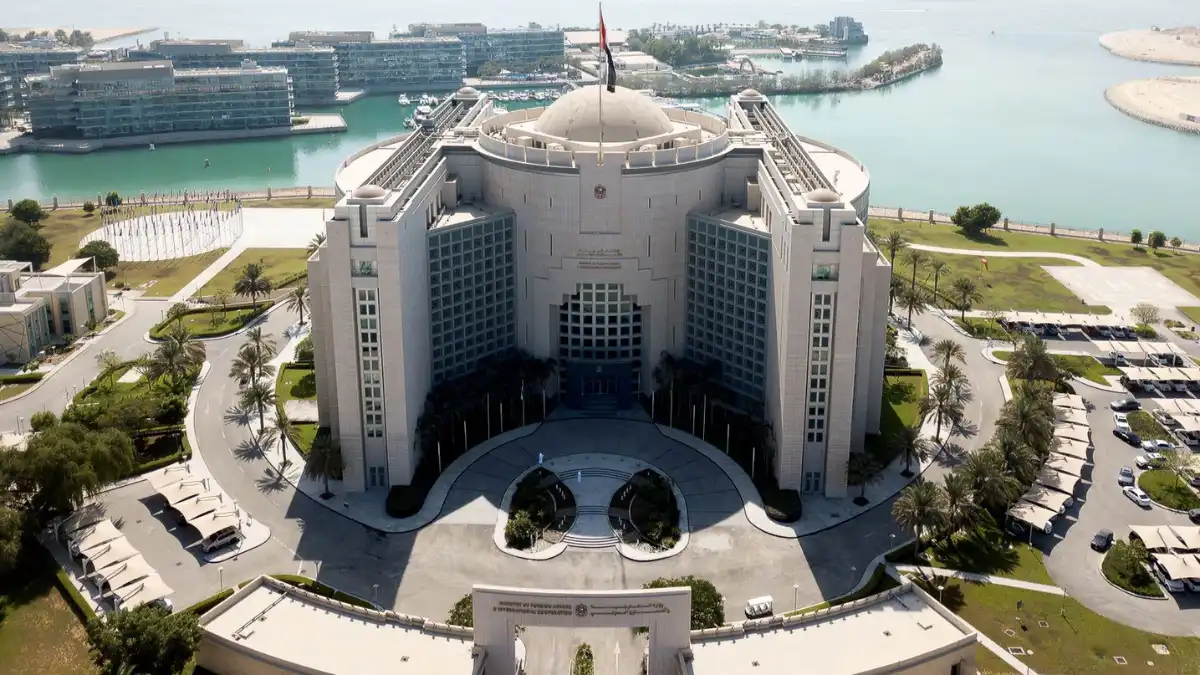
Eight major Arab and Islamic nations formed a powerful diplomatic coalition Tuesday evening, releasing a highly critical decree on regional stability. On June 2, 2026, eight major Muslim-majority countries issued a foreign ministries’ joint statement through the UAE Ministry of Foreign Affairs, condemning Israeli settler incursions at Al-Aqsa Mosque / Al-Haram Al-Sharif in occupied East Jerusalem.
Related Stories

It was signed by the foreign ministers of the UAE, Jordan, Türkiye, Egypt, Indonesia, Pakistan, Saudi Arabia and Qatar. The remarks were directly in response to the events of one of Islam’s holiest places that took place just a few days ago. It symbolises the strength of hundreds of millions of Muslims in three continents who are represented by the respective governments of these nations, and it represents an unprecedented instance of multilateral diplomatic pressure, in terms of speed and synchronisation.
What Set This Joint Statement Off?
On May 31, 2026, Israeli settlers breached the courtyards of Al-Aqsa Mosque with the help of Israeli police. Settlers hoisted Israeli flags on the steps that led to the Dome of the Rock, according to Arab News. Inside the compound, they sang and chanted the Israel national anthem. They came through Al-Maghrabah Gate which is in Israeli hands.

Condemnations were issued by UAE, Jordan, and Qatar on the same day. Within 24 hours, the foreign ministries’ joint statement came. But the 31st May incident was not an isolated one. Between May 2026 alone, the Jerusalem Governorate reported 7,244 settler entries into Al-Aqsa. A further 2,690 people came in that same month as tourists.
Palestinian officials told Anadolu Agency the pattern is part of an official Israeli policy and plan. They stated that the aim is to change the historical and legal status of Al-Aqsa by force.
Related Stories

Foreign Ministries’ Joint Statement Explained
The statement was highly critical of incursions. The ministers called them a blatant infringement of international law, of the pertinent United Nations resolutions, and of historical and legal legitimacy of the holy sites in the occupied East Jerusalem.
In addition, the statement went well beyond what happened on May 31. It deplored continued and systematic Israeli actions to alter the historical, legal and demographic character of the occupied East Jerusalem. It also condemned Israeli attempts to “desecrate the sanctity of Islamic and Christian holy places in the city.
The ministers were clear when speaking of legal custodianship. They repeated that there are 144 dunams, the total area of Al-Aqsa Mosque. It is a house of prayer only for the Muslims. Jerusalem’s Endowments and Al-Aqsa Mosque Affairs Department, which is part of Jordan’s Ministry of Awqaf and Islamic Affairs, has sole legal authority to administer the compound and control access to it.

In the joint statement, the foreign ministries reiterated the categorical rejection of any effort to change the historical and legal status quo in Jerusalem. It officially acknowledged the special responsibility of the Hashemite Kingdom of Jordan.
The ministers directly blamed the Israeli authorities on the steps toward escalation. They voiced concern over continued Al-Aqsa settler violations that heighten tensions, further the spread of instability and extremism and hinder international peace and stability. They also said these violations are a clear violation of Israel’s international law responsibilities. Therefore, all illegal and provocative practices should be immediately and totally ceased.
In the field of Palestinian rights, it reiterated the Palestinian people’s right to self-determination. The ministers supported an independent Palestinian State on the 1967 lines, with the capital of East Jerusalem. They reaffirmed their support for a comprehensive and just peace that’s built on the two-State solution, international law, the relevant United Nations resolutions, and the Arab Peace Initiative.

A Unified but Varied Coalition
The coalition backing this foreign ministries’ joint statement is as revealing as the statement itself. The eight signatories are not one and the same in their diplomatic stance with regard to Israel. Several have kept a delicate balance of bilateral engagement in recent years. In 2020, the UAE signed the Abraham Accords with Israel. But with a single coordinated text, these countries are sending a clear message.
Secondary economic and diplomatic negotiations give way to protection of religious sanctuaries. Jordan brings legal custody of the site directly to the party. Saudi Arabia has a significant influence as custodian of the two holy mosques of Mecca and Medina. The statement is extended to some of the world’s largest Muslim majority countries with Turkey, Indonesia and Pakistan.
This cross-regional alignment is intentional, aiming to bring pressure together. It would be better to have separate bilateral responses, to not mix the message. A united front will make it more difficult for the international community to view Al-Aqsa settler incursions as a local problem.
Could Strong Words Lead to Stronger Action?
The foreign ministries’ joint statement is forceful in language but it will be interesting to see what tangible action will follow. It condemns, warns, and demands. It does not name what collective steps the signatories will take if violations continue. How much pressure this coalition can endure will depend on that difference between the strong language and the lack of explicit enforcement.
The unified text can enhance the bloc’s voice in international organizations and help Palestinian diplomacy in the international arena in the short term. But the repeated incursions by the Al-Aqsa settlers have been increasing in size for more than a year without any repercussions. Likewise, the Arab Peace Initiative, to which the statement explicitly refers, since 2002 has been based on the conditionality of bringing about the state of the Palestinians in exchange for normalisation with Israel.
The further one from those two conditions moves from one to the other, the more violations he or she has accumulated. Maintaining cohesion among eight governments with differing political and economic interests will also be a persistent challenge. In contrast, a coalition that holds together through repeated provocations could shift the holy site question from a symbolic grievance into a matter with real diplomatic and economic stakes for every party involved.
Read More: Abu Dhabi Rental Increase Suspension Announced to Strengthen Tenant Protection