
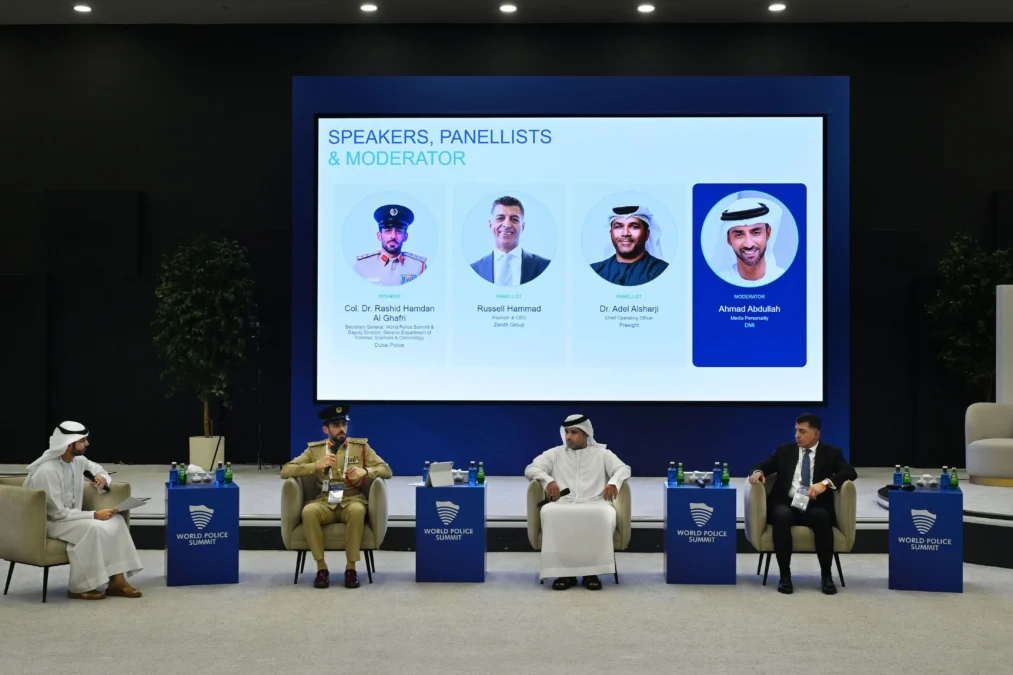
The World Police Summit 2026 Dubai hosted initial talks. It brought 13 nations to Dubai for a discussion on AI and money laundering. It also explored why digital crime leaves a physical footprint.
Why Dubai Keeps Hosting This Conversation
World Police Summit 2026 Dubai is familiar to Dubai. The fourth edition in 2025 welcomed more than 922 global leaders, officials, and experts. They came from over 110 countries.
Related Stories

The fifth edition runs from November 16th to 18th at Dubai World Trade Centre. Under the patronage of Sheikh Mohammed bin Rashid Al Maktoum, it expects participants from over 90 countries and 220 leaders. The theme this year is Connected for Impact: Uniting Global Policing to Safeguard Future Generations. Additionally, Dubai Police, in partnership with DXB LIVE, organize it.
That Dubai consistently hosts this event is not incidental. Indeed, The World Police Summit 2026 Dubai reinforces this point. The city has spent years building itself as a platform. Moreover, global security conversations translate into practical frameworks. It has the infrastructure, diplomatic neutrality, and institutional relationships.
This helps a room with Albania, Kazakhstan, Japan, and El Salvador feel like a coherent conversation.
Related Stories

The Problem That Brought Everyone to the Table
The dialogue’s central tension was articulated most clearly by the technology leaders in the room.
It is worth understanding because it shapes why AI has become so central to modern policing.

Financial crime does not respect geography. A money laundering network operates across three continents and leaves traces in Singapore simultaneously. Moreover, it also touches correspondent banks in London and cash flows in West Africa. Traditional law enforcement, built around legal borders, was not designed to move at the speed these networks require.
Dr Adel Alsharji, Presight’s Chief Operating Officer, framed the challenge and the response together. “Financial crime moves across borders, systems, and institutions.” Therefore, the response must be connected and intelligence-led, he said. “At Presight, we apply AI and agent-based capabilities to turn complex data into trusted, actionable intelligence.” This helps law enforcement identify patterns earlier, coordinate decisions, and disrupt illicit networks at scale.
The phrase patterns earlier carry more weight than they seem at first. This matters because catching a financial crime network at its peak differs from disrupting it during formation. The difference is not just about timing.
Related Stories

It is the difference between prosecuting the people who moved the money and reaching the people who controlled it.
Digital Crime Has a Physical Address
One notable moment came in the afternoon from Russel Hammad, CEO of Zenith Technologies. Moreover, he challenged the idea that digital crime only exists in systems and networks.
“Digital crime always has a physical footprint,” he said.
The lone field operative at the last mile of a distant road often resolves a global anti-money laundering case. Additionally, he then said something that has consequences well beyond policing. “Digital and physical security are no longer separate disciplines. They are the same attack surface.”
That framing matters for how institutions think about security investment. Thus, a sophisticated AI system identifies an illicit financial network. However, it is only as effective as the field officer who can act on that intelligence. It must act in a specific location at a specific moment to matter.
The chain of impact runs from algorithm to street. It breaks if either end is weak.
What November Will Actually Look Like
Colonel Dr Rashid Hamdan Al Ghafri, Secretary General of the World Police Summit, set the scale for what is coming. Additionally, more than 90 countries are involved. Moreover, over 220 leaders from law enforcement, the private sector, and academia are on a single platform. Finally, around 150 vendors showcase technologies from across the security and intelligence sector.
A new International Organisations Pavilion will appear on the exhibition floor this year. Additionally, GCCPOL leads the pavilion that brings together about 14 organisations, including ASEANAPOL, CARICOM, CARICC.
Afroz Abbo, Project Director of the World Police Summit, explained the thinking behind it. Private sector companies and start-ups have consistently expressed a desire to connect with government entities during the summit. The pavilion concentrates those connections in one place rather than leaving them to chance encounters on a large exhibition floor.
A World Police Summit app will launch soon.It will help visitors schedule meetings in advance and plan their attendance across all three days.
Friday’s preparatory dialogue marked the formal start of the countdown. Moreover, talks at the Dubai Police Officers’ Club will shape agendas and panel questions. Additionally, they will decide which partnerships form as November’s platform reaches its peak.
Ninety countries. Two hundred and twenty leaders. Three days.
The summit’s theme promises connection for impact. Friday’s session suggested the aim behind that promise is real.