GISEC Global 2026 opens at Expo City Dubai as AI transforms cybersecurity from a technical problem into a national security crisis.
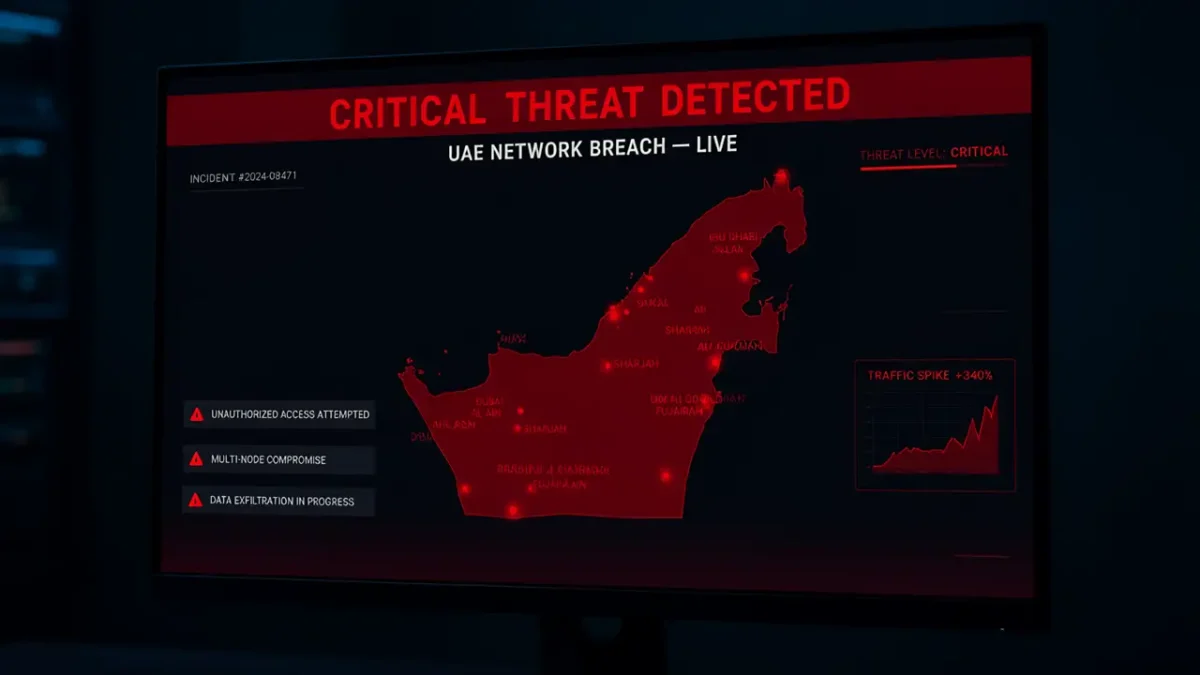
Additionally, before you finish reading, the UAE will have stopped another cyberattack. The surge is surprising, with 640,000 attacks recorded in a single day. They targeted electricity grids, water systems, aviation networks, and government infrastructure.

This trend is a reminder ahead of GISEC Global 2026 Dubai, where leaders discuss defense strategies. Protecting critical infrastructure requires rapid detection, coordinated response, and continuous improvement. That is not a statistic from a distant threat landscape. That is Tuesday in the UAE. Thousands of cybersecurity professionals from across the globe descended on Expo City Dubai on Wednesday morning. They gathered for the opening of GISEC Global 2026, the Middle East and Africa’s largest cybersecurity gathering, now in its 15th edition.
A Summit Built for a Different Kind of War
Running until September 18th under the theme Cyber First: The New Digital Order, GISEC 2026 brings together over 25,000 cybersecurity professionals, more than 750 exhibiting brands, 350-plus expert speakers and participants from over 180 countries. The event is hosted by the UAE Cyber Security Council, with the Dubai Electronic Security Center serving as official Government Cybersecurity Partner, alongside support from the Ministry of Interior and Dubai Police.
This year’s standout addition is the Cyber First Global Summit, a high-level forum pulling together government ministers, central bank governors, national cyber authorities and technology CEOs for conversations about something that was once treated as an IT problem but has quietly become a matter of economic and national survival.
The reason for the urgency is not hard to find. Ransomware campaigns are now fully AI-assisted. Malware can rewrite its own code mid-attack to avoid detection. Deepfakes are being weaponised at scale. The tools that once required sophisticated state-level resources are increasingly accessible to anyone with bad intentions and a laptop.
640,000 Attacks in One Day. What That Actually Means?
Mohamed Al Kuwaiti, Head of Cybersecurity for the UAE Government, delivered the keynote that framed the stakes most sharply. Speaking at GISEC, he confirmed that the UAE recorded 640,000 cyberattacks in a single day attacks that went well beyond nuisance-level disruption and targeted the sectors that keep a country running. Energy. Water. Telecommunications. Aviation. Healthcare. Government systems.
“AI is now embedded across technologies, but the same capabilities are being misused by attackers,” he said, pointing specifically to deepfakes, supply-chain attacks and increasingly sophisticated attempts against critical infrastructure.
His broader message was one of collective responsibility rather than individual defence. Governments, businesses, technology providers and international partners all have a role because no single entity, however well-resourced, can hold this line alone. “Governments cannot address these threats alone. Partnerships are essential to identifying and countering attacks,” he said.
Al Kuwaiti is looking beyond the immediate threat landscape. He notes that post-quantum cryptography, autonomous systems, and agentic AI are already on the UAE’s radar as the next wave of security priorities, a sign that leaders expect new technologies to be secure by design from the start. Moreover, his position is clear: security must be designed into new technologies from the outset, not bolted on after vulnerabilities have been exploited, which would leave systems exposed and undermine public trust across critical sectors around the world today collectively.
Who are the People in the Room Here?
The professionals attending GISEC are not abstract figures. They are the people whose decisions determine whether a hospital stays operational during an attack, whether a bank’s customer data remains protected, whether a city’s power grid survives a sophisticated intrusion. This year’s edition drew Brian Sullivan here for a specific purpose. He came to hear how AI is reshaping both sides of cybersecurity.
“I am interested to hear from many speakers about the trends they are seeing, particularly with the use of AI to protect enterprises, but also to understand the risks that AI poses,” he said.
For Erduan Hoxha, data sovereignty was the defining concern. “I am here to create relationships and see the main challenges around cybersecurity. Data sovereignty is a key thing,” he said. First-time attendee Farisa Khan put it most plainly. “A lot of people even with no experience can get into hacking now. That is a serious threat,” she said, reflecting a reality that Al Kuwaiti’s figures make impossible to argue with.
GISEC runs through September 18th. The conversations happening inside the Dubai Exhibition Centre this week will shape how the region defends itself for years to come.