
Altair-1 UAE commercial satellite 2026 just became the UAE’s first commercially built satellite to reach orbit. And guess what, Nine more are coming.
The country once bought its space technology. It is now manufacturing it.
Related Stories

At 11:32 on Friday morning, a rocket lifted off from a California launchpad. It carried something extraordinary into space. Not extraordinary because it was a satellite—thousands have launched over the decades. It was extraordinary because of where it was built.
Altair-1 assembled, tested and prepared for orbit inside a facility in Abu Dhabi. It rode into space aboard SpaceX’s Transporter-18 rideshare mission from Vandenberg Space Force Base. Within hours of deployment, it sent back its first signal. The satellite was working. The mission was alive.
For the company that built it, for the UAE and for the region watching, that signal meant something beyond telemetry.
From a Cleanroom in Abu Dhabi to Low Earth Orbit
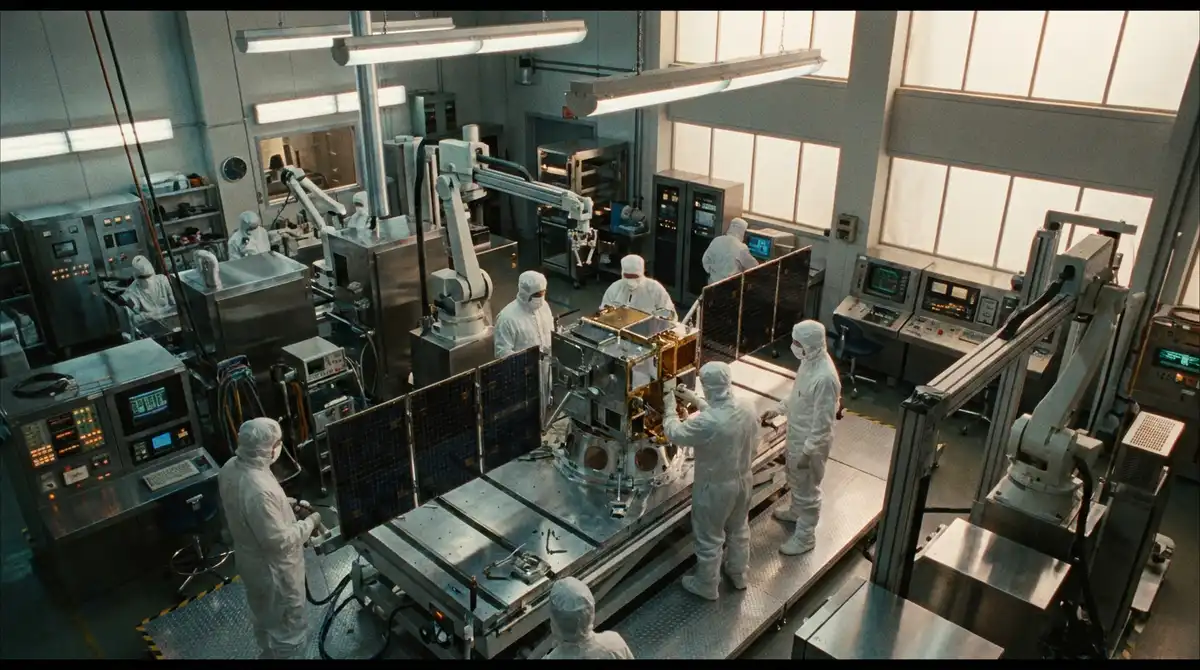
Orbitworks, a joint venture between IHC subsidiary Marlan Space and Loft Orbital, spent two years turning an idea into a functioning satellite manufacturing operation inside Khalifa Economic Zones in Abu Dhabi. The project demonstrates how regional zones support space industry growth and collaboration between established aerospace players.
The facility spans 50,000 square feet, carries ISO-class cleanroom certification across 15,000 square feet of that footprint, and houses the specialised equipment needed for satellite production, including thermal vacuum chambers, shaker tables, and electromagnetic interference testing rooms that satellite production demands.
This capacity supports upcoming missions such as Altair-1 UAE commercial satellite 2026, aligning Abu Dhabi’s space ambitions with practical manufacturing capabilities. The collaboration highlights how regional zones can transform ambitious plans into tangible, tested hardware ready for integration and launch.
At full capacity, the Abu Dhabi site can produce roughly fifty satellites annually. One per week, every week of the year. Altair-1 is the first product of that machine. The remaining nine satellites in the Altair constellation will follow over the course of 2027.
Dr Hamdullah Mohib, who leads both Orbitworks and Marlan Space, chose his words deliberately when describing what had happened. The UAE, he said, is no longer simply purchasing space capability from others. It is now producing it. Altair-1 is the opening argument in that case.
What the Satellite Can Actually Do?
Each Altair satellite packs five sensing systems into a single platform: optical imaging, shortwave infrared, thermal detection, hyperspectral analysis and radio frequency monitoring. Processing that volume of information used to require sending raw data back to ground stations and waiting hours for results.
Onboard NVIDIA processors change that equation entirely. Analysis happens in orbit. Intelligence is ready within minutes, not hours. When the full ten-satellite constellation operates in 2027, Altair will observe any location on Earth every four hours. Altair-1 UAE commercial satellite 2026 enables the same capability with autonomous passes.
The practical applications sit across several fields that matter enormously to governments and industries. Catching wildfires at their first detectable heat signature before they spread. Tracking vessels moving through sensitive maritime corridors without broadcasting their position. Monitoring agricultural land for early signs of stress or crop failure. Watching critical infrastructure for anomalies that ground teams cannot easily access.
Disaster response, environmental monitoring, national security, food supply management — the intelligence that Altair generates in real time serves all of them.
Customers Before the Satellite Even Launched
One of the most telling details about Altair-1 is that it did not go up searching for buyers. It went up with them already confirmed.
The French government, through multiple of its entities, is among the anchor customers. The Abu Dhabi Maritime Academy and the Abu Dhabi Fund for Development have both committed to the platform. Orbitworks is currently in conversations with organisations across North America, Africa and Asia about accessing the constellation’s remaining capacity.
The commercial model offers flexibility. A customer can purchase an Altair satellite outright, owning the hardware and the data stream it generates. Or they can access the same capability as a subscription service, directing specific observations and licensing the resulting intelligence without managing the underlying infrastructure.
Pierre-Damien Vaujour of Loft Orbital described the moment as the culmination of work that the UAE’s space sector has been doing largely out of public view for years. What has been built here, he said, positions the UAE to lead globally in AI-powered satellite constellation production.
The Name and the Number Behind It
The word Altair pulls from two directions simultaneously. In Arabic, al-ṭā’ir translates as the flying one, the name of a star that sailors and traders navigated by for generations across the seas connecting the Arabian Peninsula to the world. On the other side of history, the Altair 8800 was the personal computer launched in 1975 that prompted two young men named Bill Gates and Paul Allen to write their first software, launching what became Microsoft.
Navigation and beginning. Both feel relevant to a satellite that is simultaneously a UAE heritage reference and the first output of a manufacturing operation targeting a billion-dollar space economy.
Marlan Space and Loft Orbital announced in September a consortium valued at one billion US dollars alongside partners Mistral, BlackSky and MaiaSpace, with an initial phase covering fifty satellites. The UAE’s National Space Strategy 2031 targets a position among the world’s ten largest space economies. Altair-1 is the first concrete step toward that ranking.
Dr Ahmad Belhoul Al Falasi, Chairman of the UAE Space Agency, said this launch demonstrates that capabilities built inside the UAE can now generate commercial value well beyond the country’s borders, opening markets and partnerships that were not accessible before the manufacturing capability existed.
A satellite made here. A signal received from orbit. The UAE’s space economy just moved from aspiration to evidence.