The Natural History Museum Abu Dhabi is one of those rare places where science stops being a subject. It becomes an experience you carry home with you.
At some point between 4.5 billion years ago and right now, a piece of the Moon broke off, drifted through the vacuum of space, entered Earth’s atmosphere, survived the fall, landed in the Libyan desert and waited. For millennia, it sat in the sand, unremarkable to anyone who happened to pass it, because nobody who passed it knew what they were looking at.

In 2024, scientists finally did.
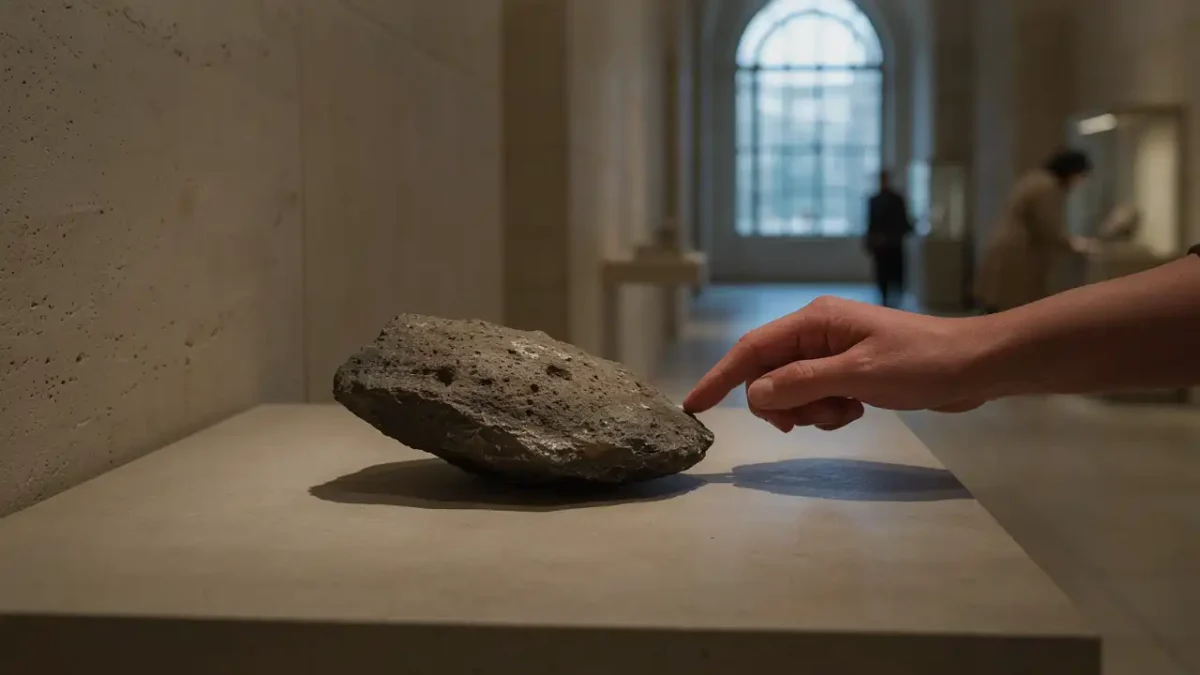
The Ash Shaqqah 002 lunar meteorite is now at the Natural History Museum Abu Dhabi on Saadiyat Island, and the museum has made a decision that deserves recognition for its quiet confidence: they let you touch it. No glass case. No barrier. Just a cold fragment of another world, and your hand, and the extraordinary realisation of what is actually happening in that moment.
History of The Museum
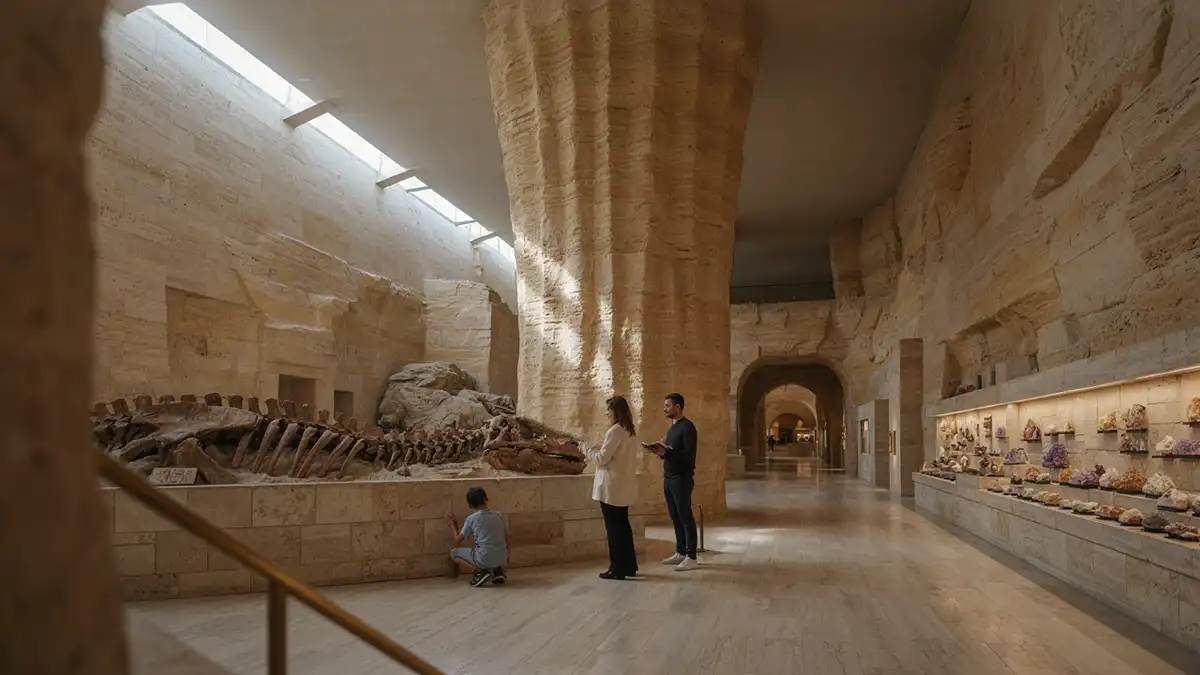
The Natural History Museum Abu Dhabi opened in November 2025, making it one of the newest major museum openings in the world and the largest natural history museum in the Middle East. It spans 35,000 square metres of gallery, laboratory and public space on an 82,000-square-metre site in the Saadiyat Cultural District, designed by Dutch architecture firm Mecanoo to resemble the geology of the UAE itself, sculpted volumes inspired by wadis, dry riverbeds, with pentagonal patterns drawn from the cell structures of living organisms.

From outside, it barely reads as a building. From inside, the entrance lobby descends like a void cut into rock, with skylights sending shafts of natural light into the space below. The architects made a structure that feels excavated rather than constructed, which is appropriate for a museum about what the earth contains.
Three public paths run through the grounds connecting the waterfront to neighbouring cultural institutions, open to everyone regardless of whether they have a ticket. The museum clearly regards being part of the landscape as part of its purpose.
Related Stories
The Story It Tells
The museum’s narrative runs from the origin of the universe to the challenges facing the planet today, structured across six main galleries that visitors can follow chronologically or explore independently.
The Story of Earth is where the moon rock lives, alongside meteorite displays and an illuminated model of the Sun. It is also where the existential vertigo of natural history first sets in, because holding your hand against something that travelled from the lunar surface to the Libyan desert over billions of years is not the same as reading about it.
The Evolving World contains Stan, a Tyrannosaurus rex that died 67 million years ago at the end of the Cretaceous period. The museum notes that the scars across his skull come from a confrontation with a larger T-Rex over a Triceratops meal. That level of specific biographical detail, delivered about a creature from 67 million years ago, is a reminder of how much forensic information a well-preserved fossil can carry.
The Lost World of Abu Dhabi does something genuinely moving. It reconstructs Stegotetrabelodon emiratus, a four-tusked elephant ancestor that roamed the land that is now Abu Dhabi seven million years ago. The exhibit describes a herd animal with social bonds and protective instincts, traits that its modern descendants still carry. The message is quiet but clear: this land has always supported life, long before anyone named it.
Human Story introduces Lucy, an Australopithecus afarensis discovered in Ethiopia’s Afar region in 1974 and dated to 3.2 million years ago. Her skeleton confirmed that bipedal movement, walking upright on two legs, predates the expansion of the human brain by a significant margin. She was named after a Beatles song that was playing at the discovery camp the night she was found.
Our World hangs a full blue whale skeleton above an immersive underwater scene. The whale reaches up to 30 metres in length and nearly 200 tonnes in weight, feeding on krill and migrating thousands of kilometres annually between polar and tropical waters. Below it, you understand scale in a way that numbers alone cannot produce.
Resilient Planet closes the narrative with climate change, biodiversity loss and the questions that confront anyone who has spent the preceding hours tracing four billion years of natural history and arrived at the present moment.
What Makes This Worth Knowing About Right Now
The Natural History Museum Abu Dhabi sits alongside the Louvre Abu Dhabi and the soon-to-open Guggenheim Abu Dhabi as part of Saadiyat Cultural District’s ambition to make one island one of the most culturally significant addresses in the world.
The museum’s embedded research laboratories are perhaps its least-discussed feature. They cover paleontology, geology, marine biology, entomology, earth sciences, and molecular research, including ancient DNA analysis. Moreover, this is not a display venue with a scientific veneer. It is a working research institution that happens to be open to the public, within Natural History Museum Abu Dhabi.
The moon rock, though, is what stays with you. Not because of what it is, though it is extraordinary. Rather, it shows what it means to stand in Abu Dhabi in 2026 and touch something from space. Humans built tools to identify it, the institutions to protect it, and Natural History Museum Abu Dhabi to share it.
That is also a kind of natural history worth recording.