December 11, 2026 marks a milestone on Saadiyat Island. The museum the UAE has built toward for two decades is almost here. The Guggenheim Abu Dhabi opening 2026 will be worth every year of the wait.
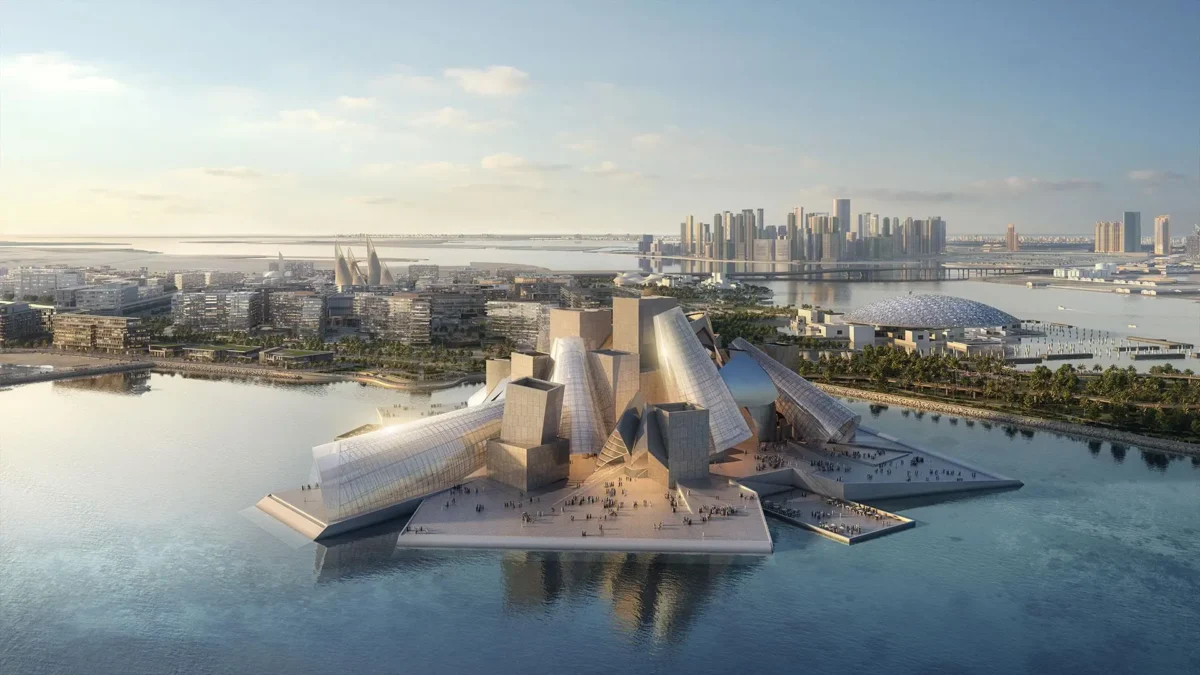
There is a kind of anticipation that comes from waiting for something extraordinary. Moreover, Guggenheim Abu Dhabi opening 2026 has been that thing for twenty years, announced, delayed, restarted, refined. It is finally set to open this December. The museum designed by Frank Gehry sits on a stretch of waterfront on Saadiyat Island. It is the largest Guggenheim in the world, larger than New York, Bilbao, and Venice.
Moreover, it carries a collection assembled since 2009 by curators who have spent nearly two decades choosing works. Their careful selections aim to present pieces that justify the museum’s stature and invite dialogue about 20th and 21st century art globally.
Tickets went on sale this month at Dh70 for general admission, bookable through guggenheimabudhabi.ae. Guggenheim Abu Dhabi opening 2026 anchors ticket information and visitor planning. Entry is free for under-18s, UAE university students and residents or citizens aged 60 and above. People of determination also enter free, with a complimentary companion ticket available at checkout.
The Building That Was Worth Waiting For
Frank Gehry’s architecture does not ask to be ignored. The late Pritzker Prize laureate, the same mind behind the titanium-clad Guggenheim Bilbao that single-handedly transformed a post-industrial Basque city into a global cultural destination designed Guggenheim Abu Dhabi as something that belongs entirely to its setting.
The building spans 80,000 square metres in total, with 11,600 square metres of indoor gallery space across 28 interconnected galleries and an additional 23,000 square metres of outdoor exhibition areas wrapping around the structure in atriums, plazas and terraces. Its most striking feature is immediately visible from a distance, ten sculptural cones rising from the building to heights of up to 88 metres, inspired by the UAE’s traditional wind towers.
These cones are not purely aesthetic. They are functional, designed to shade the building and channel air movement through the structure in a climate where summer temperatures routinely push past 45 degrees Celsius. Gehry drew from the landscape around him rather than imposing a form onto it and the result is a building that feels simultaneously global in ambition and deeply rooted in where it was built.
Inside, the galleries are not arranged in chronological order. Visitors do not walk through art history from one end to the other. Instead the collection is organised around five named themes, Abstractions, Popular Culture, Land, Language and Storytelling creating a space where connections between artists, geographies and generations emerge organically rather than being prescribed in advance.
The Collection That Has Been Building Since Before Some Visitors Were Born
The Guggenheim Abu Dhabi collection is owned by the Abu Dhabi government rather than the Guggenheim Foundation, a detail that matters enormously for what it says about long-term institutional commitment. Curators began acquiring works in 2009, and the collection now stands at over 970 works by more than 400 artists from over 70 countries. The names from the international canon are genuinely extraordinary. Jackson Pollock, Mark Rothko, Andy Warhol, Jean-Michel Basquiat, Yayoi Kusama and Anish Kapoor whose 12-metre-diameter My Red Homeland has featured in earlier previews represent the kind of collection most museums spend a century accumulating.
What makes Guggenheim Abu Dhabi genuinely distinctive, however, is who sits alongside them. The collection’s stated focus is the Gulf and the wider West Asia, North Africa and South Asia region known internally as WANASA, with regional artists presented throughout the galleries rather than segregated into a separate wing. The late Hassan Sharif, widely regarded as the father of conceptual art in the Gulf, is represented alongside Mohammed Kazem and Ebtisam Abdulaziz. Monir Shahroudy Farmanfarmaian, Samia Halaby, Rachid Koraïchi and Rasheed Araeen are also confirmed in the holdings.
This is a curatorial decision that carries genuine weight the deliberate placement of artists who have shaped the art histories of their regions beside the canonical Western names that dominate most international museum programmes.
Twenty Years, One Very Long Story
The agreement between the Department of Culture and Tourism Abu Dhabi and the Solomon R. Guggenheim Foundation was signed in July 2006. Construction began in 2011 and then stopped. It restarted in 2019. A 2023 opening was hoped for, then a 2026 target was set, and in July this year the December 11th date was finally confirmed.
Reported costs put the project at approximately one billion US dollars around Dh3.67 billion though no official total has been published. Whatever the final figure, the building that results from that investment is the fourth institution to open in Saadiyat Cultural District, joining the Louvre Abu Dhabi, which opened in 2017, alongside the Zayed National Museum, the Natural History Museum and teamLab Phenomena Abu Dhabi.
Dr Valerie Hillings, the inaugural director who has worked on the project for years, is overseeing a museum that opens into an Abu Dhabi art calendar that already includes Frieze Abu Dhabi running from November 19th to 22nd giving the emirate one of the most culturally significant final quarters of any city in the world.