
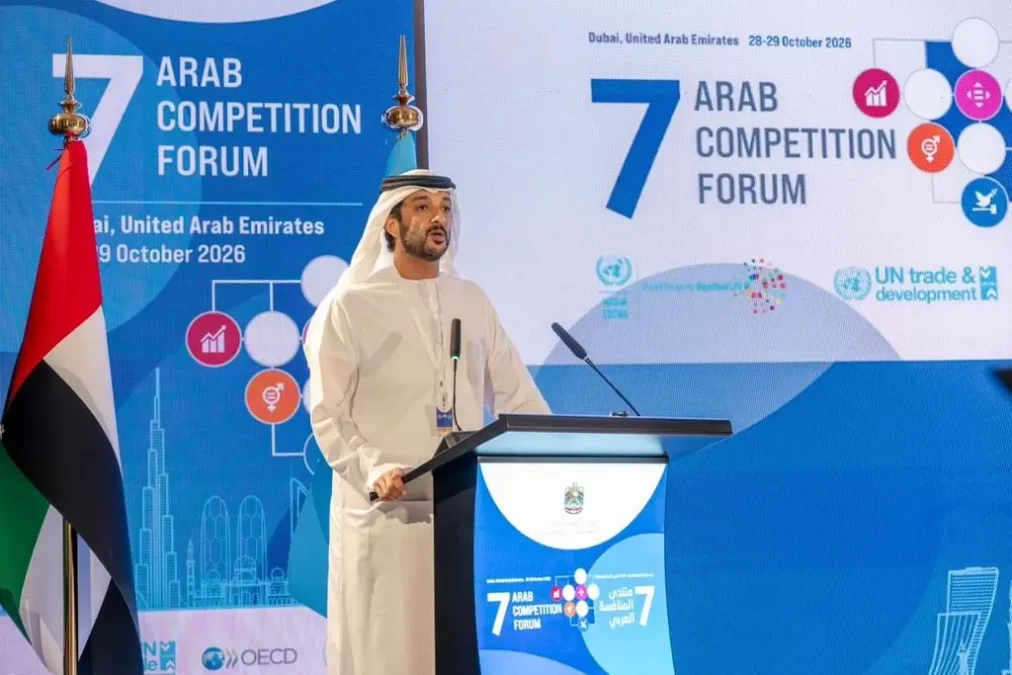
In Dubai, the seventh Arab Competition Forum raised a question every digital market in the region must answer. Who protects the challenger when the giant is already too big to challenge? Experts note the balance between innovation and regulation will shape regional competition.
This discussion aligns with Arab Competition Forum Dubai 2026. New policies may emerge to ensure fair play across startups and incumbents. The forum’s focus on balance makes Arab Competition Forum Dubai 2026 highly relevant. Participants expect concrete guidance for regulators, entrepreneurs, and investors.
Related Stories

There is a pattern that repeats across digital economies worldwide. A start-up builds something genuinely good. It gains users. It attracts attention. Then one of two things happens. A dominant platform acquires it before it scales. Or the platform quietly builds a version of the same product. It uses its existing user base to make the original irrelevant.
In both cases, the challenger disappears. This pattern matters for discussions like Arab Competition Forum Dubai 2026. The consumer never finds out what might have existed.
This is not a theoretical concern. It is the operating reality of digital markets in 2026, and it is precisely what brought senior competition authorities, economists, regulators and academics from across the Arab region to Dubai on October 28th.

The seventh Arab Competition Forum opened at the start of a two-day programme examining competition policy in the digital age, organised by ESCWA and the UAE Ministry of Economy and Tourism in partnership with UNCTAD, the OECD and the COMESA Competition Commission. The theme, competition policy in the digital age, sounds technical until you translate it into what it actually means for anyone who uses a smartphone, shops online or trusts a platform with their data.
The Problem With Being Too Big
UNCTAD Acting Secretary-General Pedro Manuel Moreno named the core tension without softening it. “Digital economies across the region are growing rapidly. But growth without competition is fragile. Promising start-ups can be squeezed out before they reach scale or acquired before they reach maturity. As a result, consumers pay more, choose less, and trust in markets erodes.”

That last phrase — trust in markets erodes — is worth sitting with. When consumers believe that the best products do not necessarily win, and that the market rewards size over merit, something more than economics breaks down. The willingness to build, to invest and to compete at all becomes harder to justify.
Data, algorithms, and network effects make this dynamic acute in digital markets. A platform with one billion users does not simply have more customers than a start-up. It has a structural advantage that compounds with each additional user, data point, and interaction.
Moreover, legislation designed for physical markets, where the largest player had more shelf space, was not built to address this. This reality informs discussions at the Arab Competition Forum Dubai 2026.
Related Stories

What the Arab Region Has Achieved and Where the Gap Remains
The picture across the Arab region is one of genuine progress followed by a more difficult question about implementation.
ESCWA assessments show that the average score for competition frameworks across Arab countries rose from 3.73 out of 7 in 2021 to 4.1 in the most recent assessment published in 2024. That is a measurable improvement in the legislative and institutional foundations for fair competition across the region.
But ESCWA Executive Secretary Rania Al-Mashat identified exactly where that progress runs up against its limits. “Legislation alone is no longer sufficient. The challenge today is to ensure its effective implementation and to empower competition authorities to keep pace with rapidly evolving digital markets.”
Writing a law that addresses digital competition is one thing. Enforcing it against a platform that operates across multiple jurisdictions, generates data faster than regulators can analyse it, and has the legal resources to contest any action indefinitely, that is an entirely different proposition.
The UAE’s Own Numbers
His Excellency Abdulla bin Touq Al Marri, UAE Minister of Economy and Tourism, opened the Forum with data that reflects how seriously the country has been taking this challenge domestically.
Between 2023 and late September 2026, the Ministry processed 85 applications for economic concentration, covering transactions with a combined value exceeding AED81 billion. The processes for evaluating these applications, which once took approximately 100 days, have been reduced to 15 days through the integration of AI-powered digital tools.

That last number matters. A regulator that takes 100 days to assess a merger in a sector where market conditions shift monthly is a regulator that is structurally disadvantaged. Bringing that timeline down to 15 days does not solve every problem in digital competition enforcement, but it removes one of the most significant structural handicaps.
The UAE’s Federal Decree-Law No. 36 of 2023 on the Regulation of Competition provides the legislative foundation. The Forum represents the regional conversation about how frameworks like this one can be adapted, shared and strengthened across multiple jurisdictions that are all navigating the same forces from different starting points.
The Student Who Said Something Worth Hearing
One of the more quietly significant moments of the opening day came during an awards ceremony for the Student Competition Challenge, launched by ESCWA and the UAE Ministry of Economy and Tourism.
First place went to Nafisabono Mominova of the American University of Ras Al Khaimah, for a paper titled Gatekeeping in the Digital Age: Apple’s App Store, Competition Policy Enforcement, and Lessons for the Arab Region.
The title alone names something that governments and regulators in major economies have been wrestling with for years — the question of whether a platform that controls both the marketplace and the rules of entry into that marketplace is structurally incompatible with fair competition. That a student at a UAE university produced a paper on this subject for a regional competition forum in 2026 says something encouraging about where the region’s next generation of economic thinkers is directing its attention.
Second place went to Sofia Abdel Latif of UAE University, and third place to a team from the University of Sharjah.
What the Forum Is Working Toward?
The two-day programme will cover four main areas: the relationship between regulation and competition enforcement in digital markets; regional cooperation for coherent digital competition policy; merger control in the digital sector specifically; and coordination between competition authorities and consumer protection bodies.
Saïd Kechida of the OECD, speaking on behalf of the OECD Competition Committee, pointed to the opportunity available to Arab governments currently investing heavily in digital infrastructure, fintech, e-commerce and AI services. “To maximise the benefits of these investments, all the authorities present should discuss ways to ensure that markets remain open, contestable, and innovative.”
CCCC Director Willard Mwemba added the necessary caution: the same technologies creating opportunity are simultaneously concentrating market power in ways that deserve serious, coordinated scrutiny.
The Forum concludes with a session aimed at producing concrete recommendations rather than broad principles. Whether those recommendations translate into coordinated regional action on digital competition is the question that the Arab region’s digital economy will need answered — and answered soon.