Etihad Rail Passenger Service Expands Across the UAE as Dubai Station Set to Open
Dubai: The UAE’s national passenger railway is entering another major phase, with Dubai and Al Dhaid passenger stations scheduled to open on September 30, 2026, expanding a service that began between Abu Dhabi and Fujairah in June.
Related Stories

Etihad Rail launched its first scheduled passenger service on June 30, 2026, when the inaugural train travelled from Fujairah to Mohammed Bin Zayed City in Abu Dhabi. The journey marked the start of the UAE’s first national passenger rail service.
The passenger network is being introduced in stages rather than launched across all planned destinations at once. Etihad Rail says the network will ultimately connect 11 cities and regions, stretching from Al Sila to Fujairah.
Dubai Station Joins the Passenger Network
The next scheduled expansion comes on September 30, when passenger services are due to reach Dubai and Al Dhaid.

According to Etihad Rail’s current rollout schedule, Zayed City and Liwa stations are scheduled to open on November 30, 2026, followed by the remaining Al Dhafra stations on December 30. Sharjah Station is scheduled to open on March 30, 2027.
This phased approach means Dubai, Abu Dhabi, Fujairah and Sharjah are part of the wider passenger network, but they are not all opening on the same date.
Related Stories

A 900-Kilometre National Rail Network
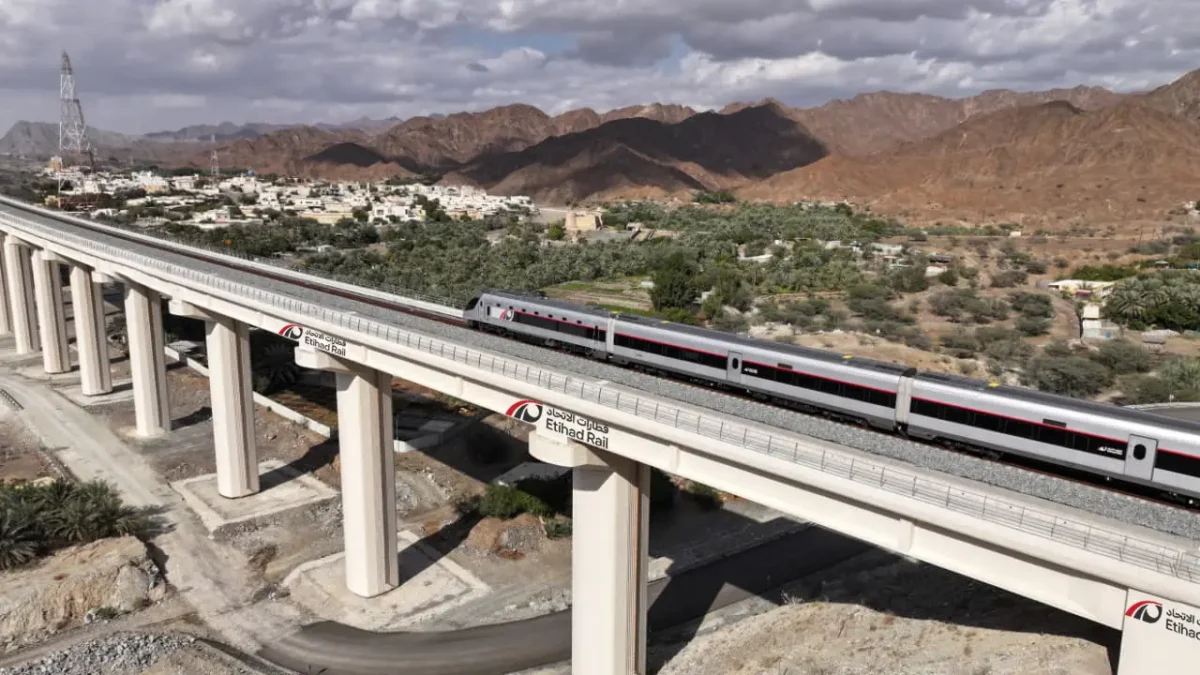
Etihad Rail’s national railway network extends approximately 900 kilometres, linking key cities, ports and industrial areas from Ghuwaifat on the Saudi border to Fujairah on the UAE’s eastern coast. The freight network is already operational, while passenger services are being added in phases.
The passenger service is designed to connect 11 cities and regions across the country. Trains can operate at speeds of up to 200 km/h, while each passenger train can accommodate up to 400 passengers. Etihad Rail has projected annual passenger numbers of 36.5 million by 2030.
The network is therefore more than a direct Abu Dhabi-Dubai commuter line. Its planned footprint connects communities and economic centres across several emirates, creating a national passenger system alongside the existing freight railway.

Abu Dhabi to Fujairah Journey Takes 1 Hour 45 Minutes
The first passenger phase has already demonstrated how the network is intended to function.
The scheduled Abu Dhabi-Fujairah service began on June 30, with the inaugural journey taking 1 hour and 45 minutes. Etihad Rail has also stated that passenger services will progressively expand as additional stations become operational.
Earlier UAE government planning documents stated that the passenger railway would eventually allow travel between Abu Dhabi and Dubai in about 50 minutes and Abu Dhabi and Fujairah in about 100 minutes, based on trains operating at up to 200 km/h.
These figures should not be confused with the separate high-speed rail project announced for the Abu Dhabi-Dubai corridor.
Separate 350 km/h High-Speed Rail Project
The UAE has also announced a separate high-speed passenger rail project between Abu Dhabi and Dubai.
Etihad Rail says the high-speed service is planned to operate on a separate, fully electrified network at speeds of up to 350 km/h, with a target journey time of approximately 30 minutes between the two cities.
That project should be viewed separately from the conventional passenger railway now being rolled out across the UAE. The 30-minute Abu Dhabi-Dubai journey is therefore not the current Etihad Rail passenger-service journey time.
What Passengers Can Expect
Etihad Rail has designed the passenger trains around regular intercity travel, with features including Wi-Fi and power outlets at seats, dedicated seating and comfortable legroom. The service is intended to provide another option for people travelling between emirates for work, family, leisure and tourism.
The passenger fleet consists of 13 trains, with each train designed to carry up to 400 passengers.
The first four major passenger stations announced by Etihad Rail were in Abu Dhabi, Dubai, Sharjah and Fujairah, although the wider 11-city network is being brought online through a phased schedule.
Why the Dubai Expansion Matters
For Dubai residents and commuters, September 30 represents an important expansion of the practical passenger network.
Dubai’s integration into the national railway gives passengers another intercity transport option alongside road travel and existing public transport. The wider network is also being designed to integrate with other modes of transport, supporting connections between railway stations and local mobility systems.
The significance of Etihad Rail is therefore not simply about replacing road journeys. Its passenger network adds a new layer to the UAE’s transport system, connecting urban centres, communities and economic destinations across the country.
With Dubai and Al Dhaid scheduled to join the passenger network this month and Sharjah planned for March 2027, the UAE’s national passenger railway is continuing its transition from a completed infrastructure project into a progressively expanding public transport service.
Sources: Etihad Rail; UAE Government; Dubai Media Office.
Read More: Etihad Rail 2026 Poised to Launch Passenger Services