
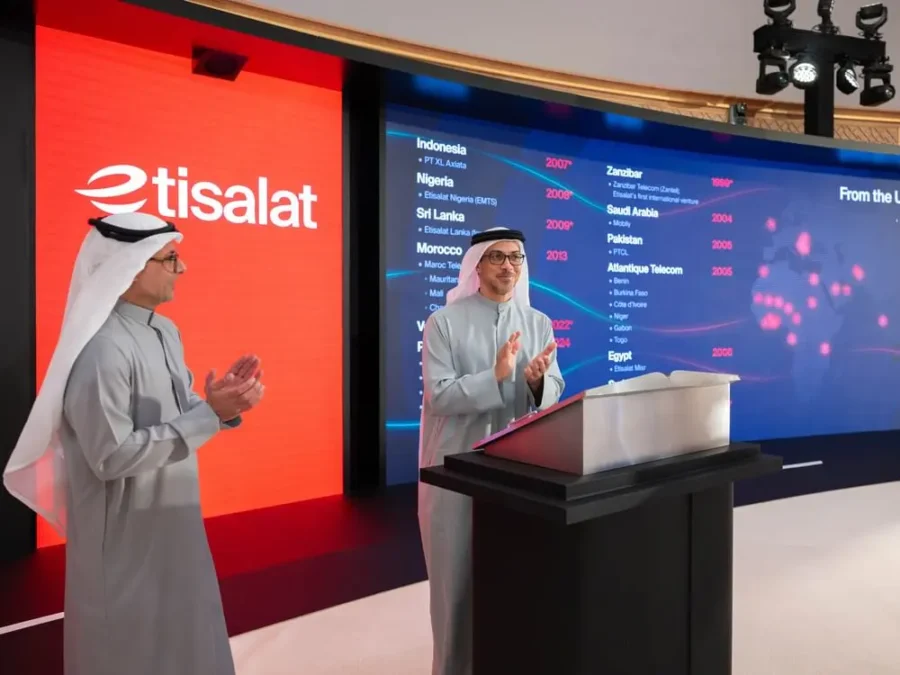
At fifty years old and just getting started, etisalat’s infrastructure announcement marks a bold UAE milestone.
It aligns with etisalat UAE digital infrastructure 2026 goals as AI grows.
Related Stories

Numbers in technology announcements have a way of losing meaning very quickly. A billion here, a terabit there, and after a while the figures blur into each other and stop conveying anything concrete.
So let us try to make this one land properly.
Etisalat currently carries international connectivity at around 20 terabits per second. That figure sounds like a lot. But it is not anymore given the pace of advancement. Emerging networks and new capacity projects now test these assumptions. The shifting landscape requires scalable upgrades across multiple regions.
The company has committed to scaling capacity to more than 500 terabits per second by 2030. That is twenty-five times today’s capacity built over four years. It spans 38 countries and serves more than 250 million subscribers worldwide. This growth aligns with etisalat UAE digital infrastructure 2026 goals.
His Highness Sheikh Mansour bin Zayed Al Nahyan, Vice President, Deputy Prime Minister and Chairman of the Presidential Court, witnessed the launch on Monday. His presence, in his capacity as Chairman of the Emirates Investment Authority etisalat’s primary shareholder, signals that this is not a corporate infrastructure decision dressed up in strategic language. It is a national commitment.
Why 500 Terabits?
The short answer is AI. The longer answer requires understanding what AI actually demands from physical infrastructure. Prompts sent to a large language model require data to travel long distances at high speeds. Additionally, the computational work happens in data centres, but the data they process must come from elsewhere. It has to travel across cables, through switching infrastructure, and across international connections with physical limits.
Finally, this underscores etisalat UAE digital infrastructure 2026.
Those limits are becoming visible. Meanwhile, global data traffic has been growing faster than infrastructure investment for several years. AI is accelerating that gap dramatically. A single large AI training run can consume more bandwidth than an entire enterprise’s annual data usage.
This was the case a decade ago.
The etisalat project is a direct response to that pressure. This aligns with etisalat UAE digital infrastructure 2026 goals. Diversified international routes and low-latency design expand capacity to the UAE and networks, ensuring demand surges won’t bottleneck UAE ambitions.
Fifty Years Old, Completely Rebuilt
The timing of this announcement, on the occasion of etisalat’s 50th anniversary, is not coincidental.
The company that began as a state telecommunications operator in 1976, when calling internationally from the UAE required booking time in advance and connections dropped regularly, is now revealing what it intends to be for the next half century. An AI-powered and AI-enabling telco, operating under the etisalat name that its customers have trusted for five decades, built around four business engines: telecommunications, AI and business solutions, infrastructure and fintech.
This infrastructure project is explicitly the first major commitment of that new strategic direction. Jassem Mohamed Bu Ataba Alzaabi, Chairman of etisalat group, made the company’s ambition specific rather than rhetorical. Moving connectivity from 20 to 500 terabits per second, he said, is about meeting the growing challenges of global data processing, supporting AI campuses inside the UAE, serving global cloud providers and ensuring that the UAE controls rather than simply accesses its own digital infrastructure.
That phrase, digital sovereignty, is increasingly central to how advanced economies think about technology infrastructure. Building the cables and routing them through your own territory rather than depending on routes that others control is both a technical and a geopolitical decision.
The UAE’s Progress So Far
This announcement does not exist in isolation. The UAE has been assembling the components of an AI-ready economy methodically for several years. The National AI Strategy targeting artificial intelligence integration across government services. The Dh150 billion commitment to data centre and digital infrastructure investment announced earlier this year. The UAE’s position as the first country in the world to appoint a dedicated Minister of AI, a role created in 2017 when most governments were still treating AI as a research concern rather than a policy priority.
Sheikh Mansour was direct about the underlying philosophy: the UAE’s ambition is not to adopt technologies that others build. It is to contribute to building those technologies and governing how they develop.
A 500 terabit network does not achieve that on its own. But it makes everything else possible, the AI campuses, the cloud infrastructure, the real-time data processing across the digital economy that the next decade will require.
The foundation comes first. Everything that gets built on top of it depends on whether the foundation can carry the weight.