
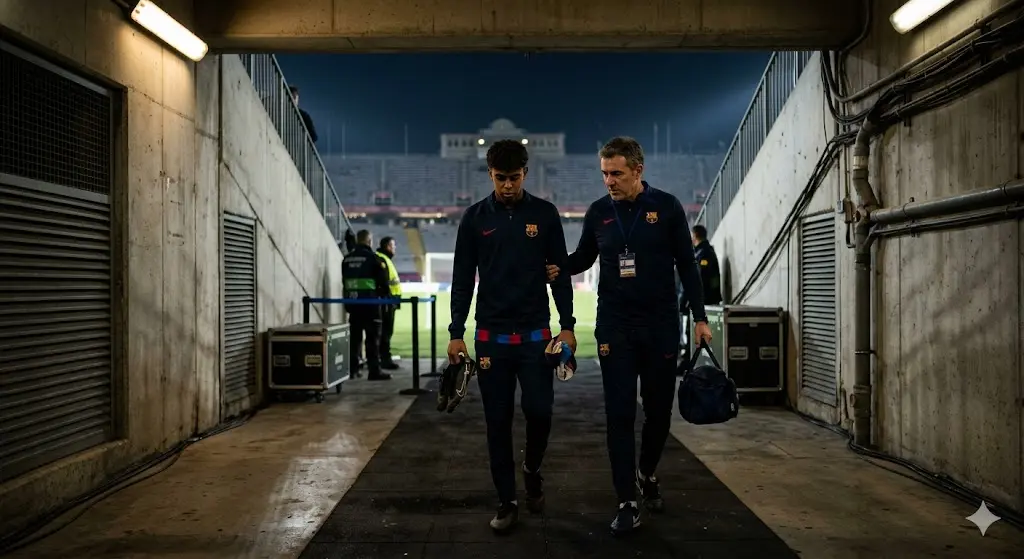
A Rising Star Interrupted
At just 17, Lamine Yamal has already moved beyond the label of a future talent. For FC Barcelona and the Spain national football team, he is part of the present. That is why his recent injury carries more weight than a routine setback.
The issue, a muscle problem in his lower leg picked up during the latter phase of the season, arrives at a moment when both club and country are navigating important fixtures. The question is not just when he returns, but what this interruption means for a player whose role has been expanding rapidly.
Understanding the Nature of the Injury
Yamal’s game is built on constant movement. His ability to accelerate, stop sharply, and change direction in tight spaces defines how he influences matches. A lower-leg muscle injury directly affects those actions. Even after recovery, the real challenge lies in regaining confidence in those movements.
For players who rely on instinct, hesitation becomes the biggest obstacle. This is what makes the situation more complex than a simple timeline. It is not just about being declared fit, but about returning at the same level of sharpness.
Impact on Barcelona’s Structure
Barcelona’s attacking play this season has often depended on width and individual progression. Yamal provides both, not just by holding position on the flank, but by carrying the ball forward under pressure. His absence changes the rhythm of the attack.
Without that direct outlet, the team leans more toward controlled build-up, circulating possession rather than breaking lines quickly. The system still functions, but it becomes more predictable. The spaces where Barcelona usually gain momentum — wide areas and half-spaces — lose some of their threat without him.
Spain’s Tactical Dilemma
For Spain, the situation introduces a different kind of uncertainty. Yamal offers a profile that brings verticality and directness to their attack, something that contrasts with their traditional emphasis on control. With key matches approaching, the timing of his return becomes crucial.
Building around him requires patience, while moving away from him means losing a key attacking dimension. This creates a balance between long-term planning and short-term necessity, where decisions are shaped as much by fitness as by tactical needs.
Development at a Critical Stage
At this stage of his career, continuity is as important as performance. Young players develop through repetition — reading defensive setups, improving decision-making, and adapting to the intensity of top-level football.
An injury interrupts that process. Even a brief absence can affect rhythm and delay progression. For Yamal, this is not just time away from the pitch; it is a pause in a phase where everything was moving forward quickly.
Managing the Return Carefully
The focus now shifts to how he returns. Yamal has already been heavily involved across competitions, and that level of exposure demands careful management.
A gradual reintegration, controlled minutes, and reduced physical overload will be essential. Bringing him back too quickly could risk further setbacks, which would be far more damaging than the initial injury. The priority is not just recovery, but sustainability.
More Than a Temporary Absence
This injury is not severe in isolation, but its timing makes it significant. It interrupts a period where Yamal’s influence was growing with each game.
Barcelona can adjust their structure, and Spain can adapt their approach, but for Yamal, the real challenge lies in returning with the same freedom that defines his game. Because at his level, recovery is not just about availability — it is about playing without hesitation.
Real Also: Barcelona 0-2 Atletico Madrid: Tactical Discipline and Clinical Edge Punish 10-Man Barcelona
Related Stories