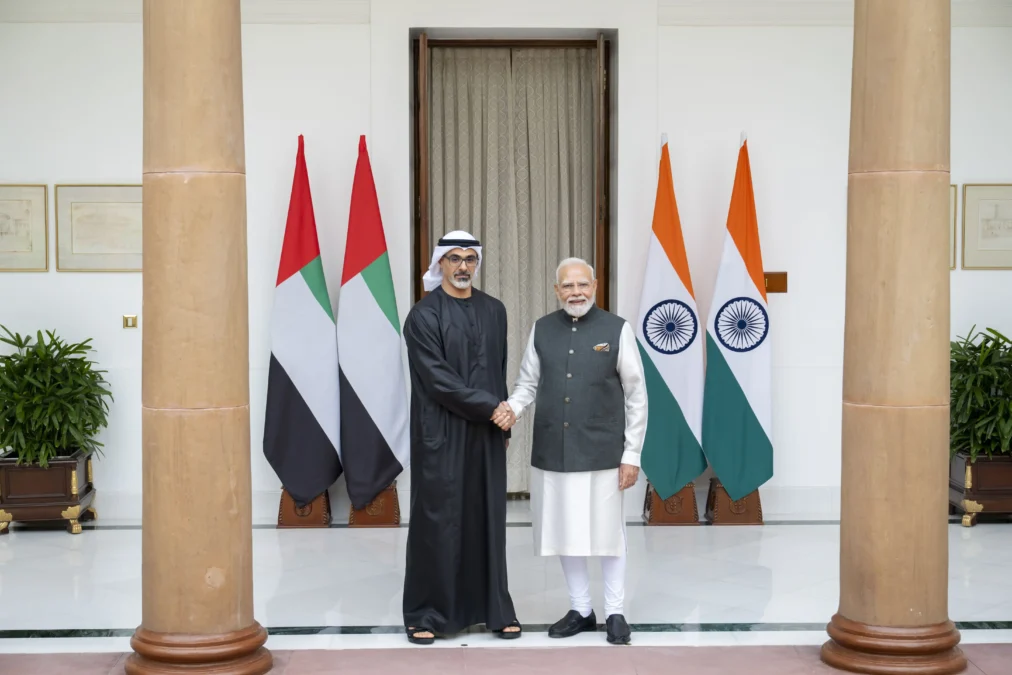
Hyderabad House in New Delhi has hosted some of India’s most consequential diplomatic conversations. On September 12th, it added another one to that list. Sheikh Khaled bin Mohamed bin Zayed Al Nahyan, Crown Prince of Abu Dhabi, sat down with Prime Minister Narendra Modi. The meeting occurred on the margins of the 18th BRICS Summit.
Moreover, the conversation covered Aluminium and nuclear energy. Defence, space, and investment frameworks worth billions were discussed as well. This marks rapid momentum toward the UAE India BRICS Summit 2026 and the growing partnership. This was a working meeting. The partners have clearly decided the pace of their partnership must accelerate.

A friendship with deep roots
The UAE and India are not new to each other. Their relationship stretches back decades through trade routes, energy agreements and a shared human story written by over three million Indians who have built their lives and careers across the Emirates.
The Comprehensive Economic Partnership Agreement, which came into force in 2022, gave that relationship a formal commercial backbone. Since then, both governments have treated it not as a finishing line but as a starting point. Sheikh Mohamed bin Zayed Al Nahyan travelled to India in January 2026. Modi came to the UAE four months later in May. The September meeting in New Delhi is the latest chapter in a pattern of engagement both sides appear genuinely committed to keeping alive.
The deal that stood out
Among everything discussed, one announcement drew particular attention. Moreover, UAE’s International Holding Company confirmed plans to back a USD 11.5 billion integrated greenfield aluminium project in Odisha. Additionally, it would be the single largest integrated aluminium investment India has ever seen.
During the UAE India BRICS Summit 2026, both leaders noted the significance of the project during their talks.
Beyond the headline number, the investment carries strategic weight. Odisha, already a significant industrial state, is being positioned as a future global centre for aluminium manufacturing. For the UAE, putting capital of this scale into India’s industrial infrastructure marks a meaningful shift, from a relationship defined by trade and energy into one increasingly shaped by long-term productive investment.
BRICS as common ground
The summit setting gave the bilateral conversation a multilateral dimension worth noting. Modi acknowledged the UAE’s active role within BRICS since joining as a full member in January 2024, particularly during India’s chairship. Both sides agreed to keep coordinating through the platform on shared priorities, a signal that the UAE’s BRICS membership is already functioning as a bridge between Abu Dhabi and New Delhi on the global stage.
The delegation present
The UAE arrived in New Delhi with a delegation that reflected exactly how seriously this meeting was taken. Reem Al Hashimy, Minister of State for International Cooperation, was present alongside Dr Sultan Ahmed Al Jaber, Minister of Industry and Advanced Technology, and Dr Thani bin Ahmed Al Zeyoudi, Minister of Foreign Trade. Jassem Mohamed Bu Ataba Al Zaabi, Chairman of the Department of Finance in Abu Dhabi, also attended.
Ministers of trade, industry, finance and international cooperation in the same room says something about intent.
Energy, nuclear power and what is next
The energy dimension of the UAE-India relationship has always been one of its strongest pillars. The New Delhi meeting reinforced that.
Moreover, this momentum aligns with the UAE India BRICS Summit 2026 discussions. ADNOC’s 15-year LNG agreement with IndianOil covers one million metric tonnes annually. The deal comes from the lower-carbon Ruwais LNG project and supports storage cooperation. A strategic oil storage framework between ADNOC and Indian Strategic Petroleum Reserve Limited was also acknowledged.
Nuclear cooperation took on fresh significance. The Emirates Nuclear Energy Corporation and India’s Nuclear Power Corporation formalised a knowledge-sharing partnership, creating a structured framework for exchanging expertise across nuclear energy development. The UAE’s nuclear programme, recognised internationally as a model for emerging nuclear nations, gives this agreement genuine depth beyond paper commitments.
Both leaders also flagged defence, space and technology as priority areas for deeper cooperation going forward.