
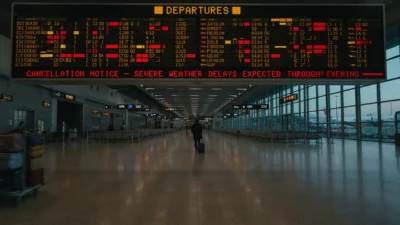
British Airways flights’ suspended status has now been extended by a full month. The carrier pushed back its planned resumption of services to Dubai, Doha, and Tel Aviv to August 1, citing the ongoing situation in the Middle East, according to a Khaleej Times report on Tuesday, May 19. The airline had previously indicated a July restart. That timeline has now shifted again.
“Due to the ongoing situation in the Middle East, we have made further changes to our flying schedule to provide greater clarity for our customers,” a British Airways spokesperson said in an emailed statement. The airline, which is owned by International Airlines Group (IAG), added that it is keeping the situation under constant review and is directly contacting affected customers to offer a range of options.
What Changes When Flights Resume
It’s not a postponement. It also involves changes to the way British Airways will fly in the region when it returns. Once they resume, the carrier will be cutting back on Middle East operations, with only one flight daily to Dubai, Doha, Riyadh and Tel Aviv. That’s a significant drop in the numbers from before the war when the Dubai route had several flights daily, and was one of the world’s busiest air corridors.
Moreover, British Airways flights have permanently removed Jeddah from its list of destinations, something announced by the company in April which has yet to be revised. Jeddah is truly not included in the re-started network. Those who depended on direct flights from British Airways to the second largest city of Saudi Arabia are now no longer able to benefit from such flights.
According to British Airways’ travel news page, travellers originally set to fly to or from Abu Dhabi, Amman, Bahrain, Doha, Dubai, Tel Aviv, Jeddah and Riyadh until November 31, 2026, will be able to change travel dates. The breadth of those routes really does illustrate what a broad array the suspension offers for routes other than the three mentioned in the headline.
Related Stories


British Airways Flights: Wider Retreat
British Airways isn’t the only one. Suspension of extension on the British Airways flights comes as part of the trend of European carriers playing it safe when it comes to resuming flights from the Middle East. The Lufthansa Group has the most comprehensive suspension policy in Europe: flights to Dubai, Abu Dhabi, Riyadh, Muscat, Tehran, Beirut and Tel Aviv are suspended for longer periods. Singapore Airlines has announced that its operations to Dubai will be suspended until August 2026. Finnair has cancelled Doha. Cathay Pacific has extended suspensions on both Dubai and Riyadh.
Rerouted flights between Europe and Asia are adding 45 minutes to three hours to selected long-haul services, increasing operating costs by an estimated 8 to 15 percent per rerouted flight. Average airfare prices on Europe to Asia routes have risen 12 to 22 percent as a direct consequence of rerouting measures and reduced airline competition on Gulf corridor connections. Those cost pressures are not going away by August 1. They are the structural reason why airlines are not rushing to resume.
Related Stories

This is a stark contrast with Gulf carriers. Emirates has restarted flights to 137 destinations in 72 countries, and is spearheading the recovery of the Gulf carrier. Qatar Airways is looking to expand to 150 or more destinations. Airlines from UAE and Gulf are flying from their home soil with full clarity of regulations. European carriers are weighing if it’s worth recommencing routes that are facing greater insurance premiums, fuel surcharges and reputational risk should a repeat happen on them.

For Dubai-UK Travellers
The August 1 date offers a definite indication of planning ahead, as opposed to previous open-ended suspensions, for the roughly 350,000 British nationals residing in the UAE and the millions of British tourists who come to Dubai each year. It’s also news that direct flights between London Heathrow and Dubai by British Airways will not be flying for the next 10 weeks.
Emirates, which has never stopped flights between London and Dubai, continues to fly a few times a day. There is an alternative for travellers who may require Air travel between the UK and UAE in June or July. The reduction is not a loss of connectivity, it’s a loss of choice and competition. But the return of British Airways to the Dubai market in August will take away one of the biggest competitors from the world’s third busiest international aviation corridor, exacerbating the already high ticket prices for passengers.
Related Stories

British Airways flights will be continuing to watch the situation closely and will be reaching out directly to any customers impacted by the situation with the most up-to-date information and available options as the situation evolves.
Read More: UAE Space Cooperation Programme Backs Mars-to-Moon Run