

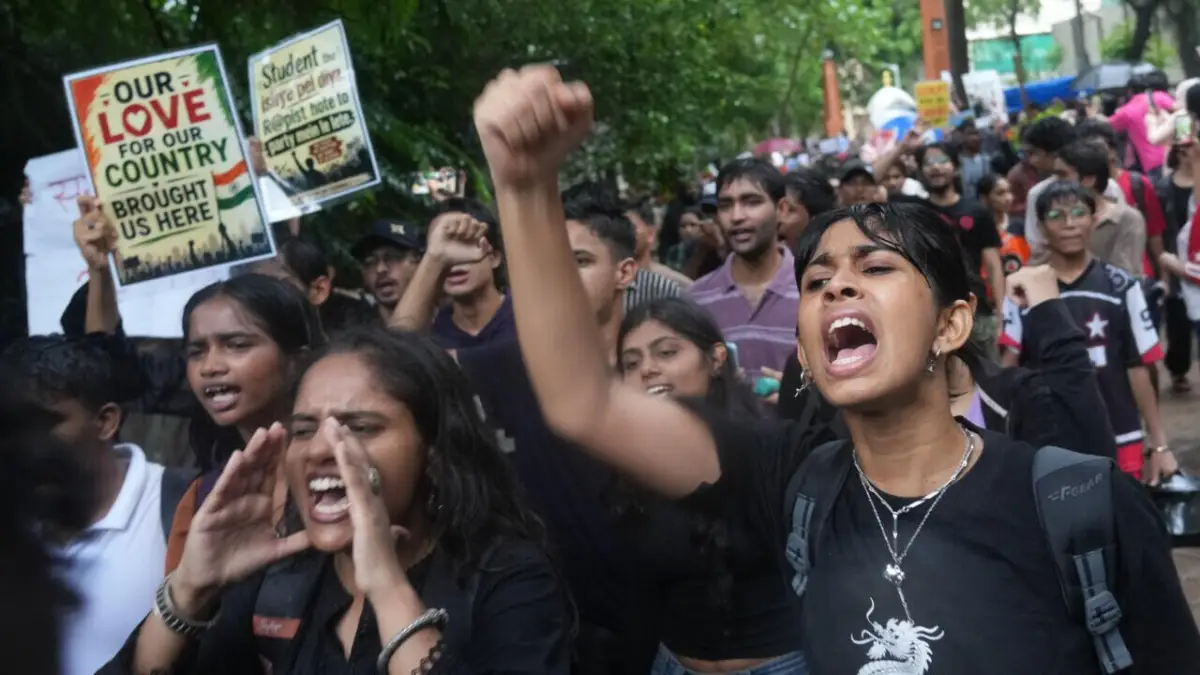
The Cockroach Janta Party protests India have emerged as one of the country’s largest youth-led movements in recent years, transforming a satirical social media post into a nationwide campaign demanding accountability from Prime Minister Narendra Modi’s government. Led by political communications strategist Abhijeet Dipke, the movement has drawn tens of thousands of protesters to New Delhi over allegations of examination paper leaks, rising unemployment, and growing frustration among India’s youth.
What began as a six-word social media post has evolved into one of the most significant youth-led protest movements India has witnessed in over a decade. The phrase, “What if all cockroaches come together?”, posted on X by political communications strategist Abhijeet Dipke in May, has become the rallying cry for millions of young Indians frustrated by unemployment, examination paper leaks, and demands for greater government accountability.

The post was a satirical response to remarks made by Supreme Court judge Surya Kant, who compared unemployed youth to “cockroaches” during a speech. Although the judge later clarified that his comments had been misconstrued, Dipke’s post quickly went viral, giving rise to the satirical “Cockroach Janta Party” (CJP), which has since transformed into a major protest platform.
Mass Demonstrations Over Examination Scandal
The movement gained momentum following allegations of widespread leaks in India’s medical entrance examination, affecting nearly two million candidates. The controversy, coupled with reports linking the scandal to several student suicides, has fuelled public anger.
Related Stories

Over the past several days, tens of thousands of protesters have gathered at Delhi’s Jantar Mantar, demanding the resignation of Education Minister Dharmendra Pradhan and calling for accountability in the conduct of competitive examinations. Smaller demonstrations have also been reported in cities including Mumbai.

The protests have become the most visible public challenge to Prime Minister Narendra Modi’s government since it came to power in 2014.
Dipke Returns From the United States
Thirty-year-old Dipke, who had been pursuing a master’s degree in public relations in Boston, returned to India in early June after the movement gained unprecedented traction online.
Related Stories

Since arriving in New Delhi, he has become the most recognisable face of the protests, regularly addressing crowds while urging demonstrators to maintain peaceful methods despite growing tensions.
His prominence increased further after police action against protesters earlier this week drew widespread criticism and intensified public support for the movement.
Background Shapes Political Outlook
Born in Aurangabad, Maharashtra, Dipke comes from a Dalit family, one of India’s historically marginalised communities. He has frequently spoken about his family’s modest background, noting that his father grew up in poverty and his grandfather worked as a farmer.
His political views have been strongly influenced by Dr B.R. Ambedkar, the principal architect of India’s Constitution and a leading advocate for Dalit rights. Upon returning to India, Dipke was seen carrying a copy of Ambedkar’s autobiography, symbolising his ideological roots.
Last week, a woman threw blue ink at Dipke during a public address, accusing the movement of disrespecting the Hindu deity Lord Ram. Dipke later responded by posting a video of the incident with the caption, “Blue is my colour,” a reference to the colour associated with the Ambedkarite movement.
From Digital Satire to Political Mobilisation
Dipke previously worked with the social media team of the Aam Aadmi Party (AAP), where he developed expertise in political communication through humour, memes, and satire. Although he is no longer affiliated with the party, AAP and several opposition groups have expressed support for the ongoing protests.
The movement’s rapid expansion was aided by Delhi-based YouTuber Meghnad S., who, along with a colleague, used artificial intelligence tools to create a satirical website announcing the formation of the Cockroach Janta Party. The accompanying Instagram account attracted millions of followers within days and has since grown to approximately 25 million followers, highlighting the movement’s remarkable online reach.
A Movement Beyond Social Media
Despite receiving threats directed at himself and his family, Dipke decided to return to India, stating that he intends to remain until students receive justice.
Since early June, he has remained at the protest site, frequently interacting with demonstrators, speaking to the media, and appealing for non-violent demonstrations.
Addressing supporters during a recent gathering, Dipke reaffirmed the movement’s resolve, declaring that the campaign would continue until its demands were met.
What started as a satirical online comment has now evolved into a nationwide youth movement that has reshaped India’s political conversation, placing issues of education, employment, and accountability at the forefront of public debate.
Read Also: Cockroach Janta Party: Elite Slur To A Massive Political Hit