
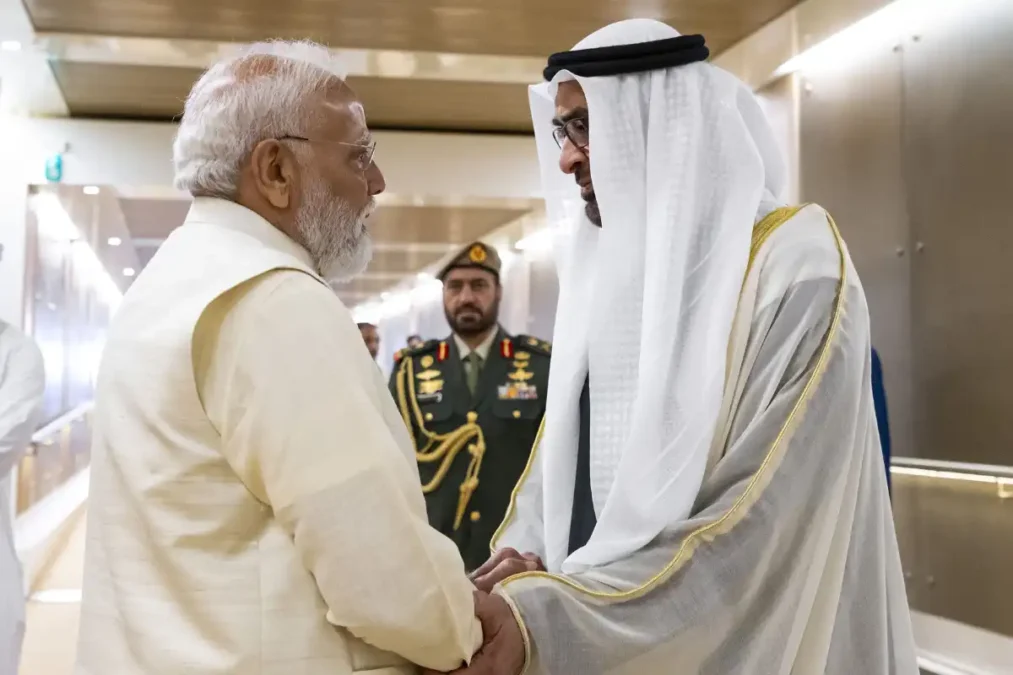
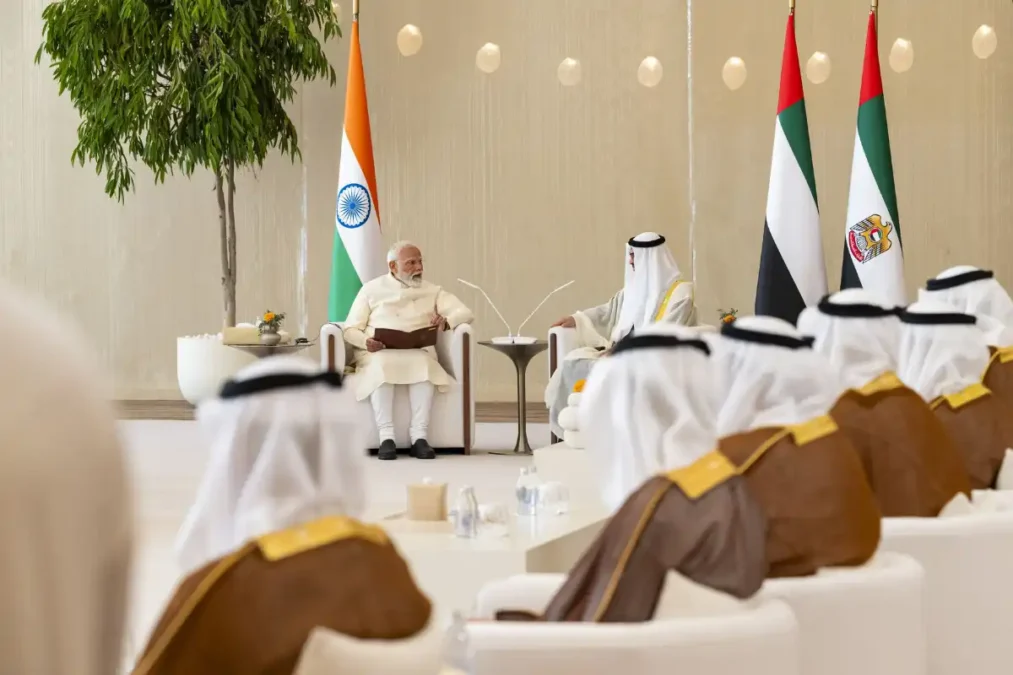
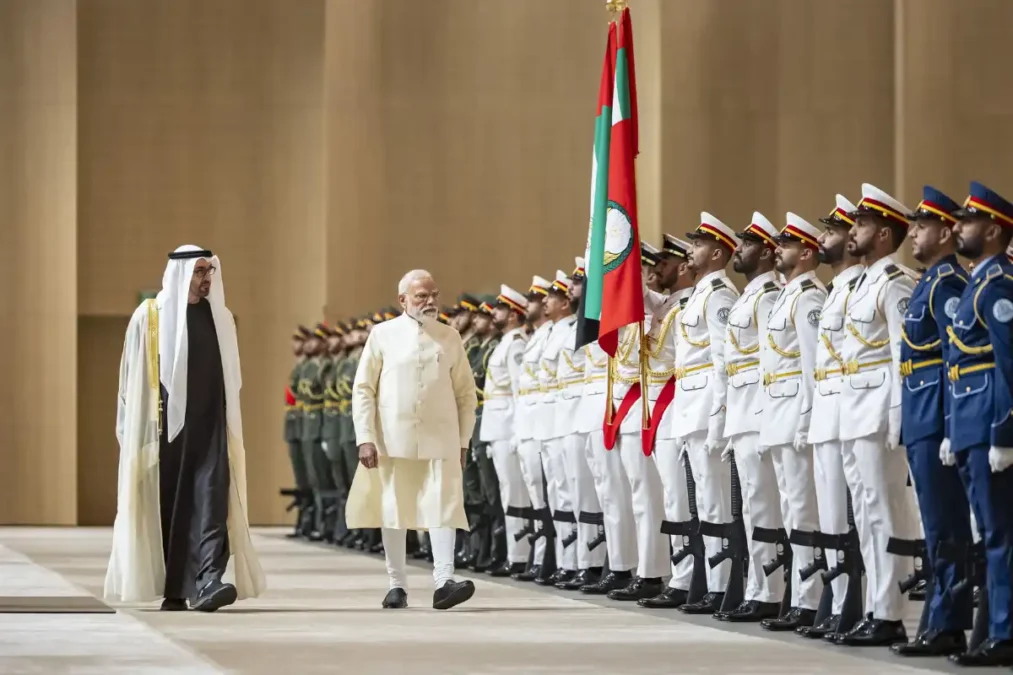
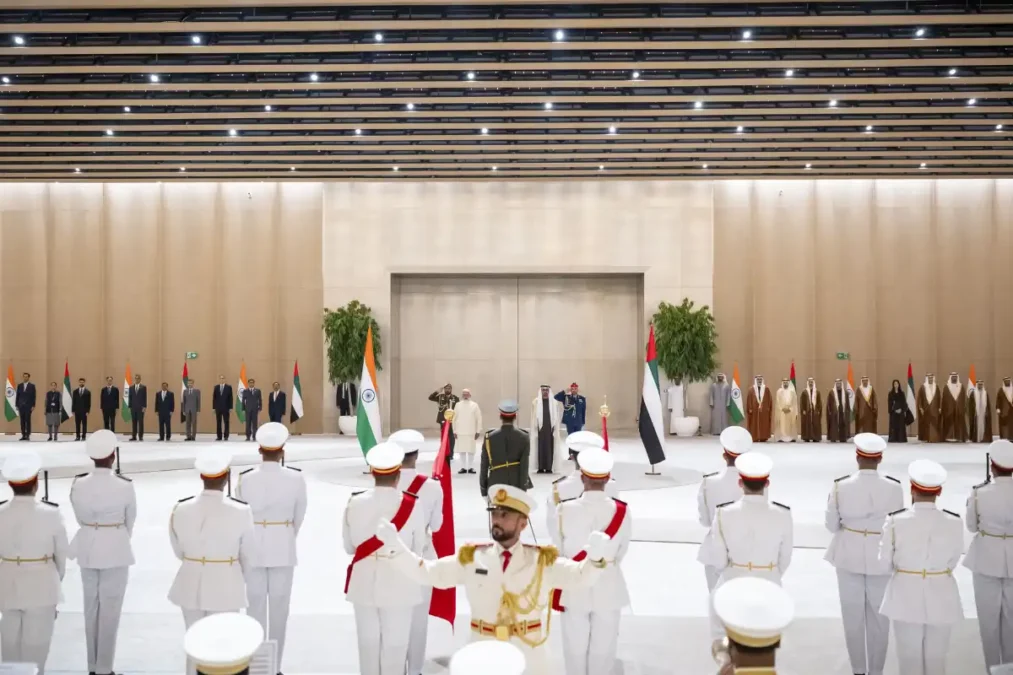
On Friday, May 15, Indian Prime Minister Narendra Modi met UAE President Sheikh Mohamed bin Zayed Al Nahyan in Abu Dhabi. The visit produced a $5 billion India UAE investment commitment. It also produced something harder to quantify but equally important. It acknowledged that the partnership between the world’s largest economy and the most business-savvy region in the Middle East has come a long way from mere statistics and is now entering a new phase of strategic partnership with South Korea.
Relationship Background
The UAE trip comes in Modi’s seventh visit to the UAE since his term as prime minister began in 2014. His first visit was in 2015, being the first Indian Prime Minister to visit the UAE after 34 years. The partnership was elevated to a strategic level, called the Comprehensive Strategic Partnership, in 2017 when Sheikh Mohamed visited India. Ever since, both countries have progressed from symbolic friendship towards structural economic integration.
That’s reflected in the numbers. India and the UAE signed the Comprehensive Economic Partnership Agreement (CEPA) on 12th May 2022. According to AGBI’s reports on the visit, bilateral trade reached $101.25 billion, well surpassing the $72 billion mark in fiscal year 2022, for the first time during fiscal year 2025 to 2026. UAE is the third largest trading partner of India and has more than 4.5 million Indians residing there. Further, both leaders agreed to increase bilateral trade to $200 billion by 2032 at a meeting between the two leaders.
India UAE Investment: The Deals Signed
The UAE committed $5 billion in India, covering infrastructure, banking, and financial sector investments. Specifically, the funds will flow toward RBL Bank, Sammaan Capital, and Indian infrastructure projects, according to News9Live reporting on the visit. Official breakdowns reveal that Emirates NBD is deploying $3 billion directly into India’s banking sector via RBL Bank, while the Abu Dhabi Investment Authority (ADIA) and the International Holding Company (IHC) are injecting $1 billion each into the National Infrastructure Investment Fund (NIIF) and Sammaan Capital respectively.
In addition to the India UAE investment number there are four specific contracts. The two nations signed the framework agreement of the Strategic Defence Partnership, which marks an increasing military and security cooperation. Second, the UAE and India signed an agreement on LPG supply and cooperation with India’s Strategic Petroleum Reserve, significantly increasing the UAE’s footprint of crude storage in India, from 5.5 million barrels to an unprecedented 30 million barrels and charting out the future strategic reserves of the LPG and LNG, bringing energy security to the formal agenda of the relationship.
Third, a memorandum of understanding has been signed for the formation of a ship repair cluster at the port of Vadinar in Gujarat in a joint attempt of Cochin Shipyard Limited (CSL) and Dubai’s Drydocks World, thus furthering cooperation between maritime and industrial infrastructures. Fourth, a groundbreaking technology agreement to construct an 8-Exaflop AI supercomputing center in India with support from Cerebras’s technology and in collaboration with UAE’s G42.
The defence dimension is the most strategic of the three dimensions. Historically, the UAE and India have not had a formal security relationship. The formalisation is an indication that both governments see an advantage in reaching beyond trade to formalise new avenues for cooperation, at a time when the UAE has been directly impacted by a regional war.
The War Backdrop
During the visit, Indian PM Modi spoke about the conflict in the region directly. He also voiced worries about the wider consequences of the conflict in West Asia, and reiterated his call for the freedom of the Strait of Hormuz for international trade and energy transportation. India has been a neutral country in the war. But India’s energy imports have taken a hit due to the Strait of Hormuz closure. Import of petroleum products and LPG from the Gulf is a crucial driver of the Indian economy. The energy deals reached on Friday directly tackle that weakness.
Prashant Gulati, president emeritus of the Entrepreneurs Organisation TiE Dubai, told AGBI that the visit highlights the urgency and commitment to grow and look beyond the limitations imposed by the war. That framing captures the spirit of Friday’s meetings. Both sides are choosing to deepen a relationship while the regional environment makes doing so more complex, not less.
India UAE Investment: Future Outlook
The $5 billion India UAE investment announced on Friday sits within a longer arc. The two governments have set a $200 billion bilateral trade target for 2032. Furthermore, the India UAE relationship has diversified into defence, energy, technology, and artificial intelligence. India’s large and growing digital economy is an attractive destination for UAE sovereign capital.
Meanwhile, the UAE’s infrastructure, financial services expertise, and Gulf connectivity offer Indian companies exactly the kind of regional access they seek. This is further optimized by operationalization of the METRI virtual trade corridor that dynamically connects the ports of India and UAE for the efficient utilization of maritime trade.
The fruits of the visit would “further strengthen our friendship and contribute to growth and prosperity,” Modi said. The latter maybe seen as diplomatic talk by many, but it is also the true state of the results of a decade of progressive engagements. India and UAE relations are one of the most significant bilateral relations in the region. Friday’s $5 billion investment confirms it is continuing its in-depth investment.
Read More: FIFA World Cup 2026: Why India still has no Official Broadcaster