
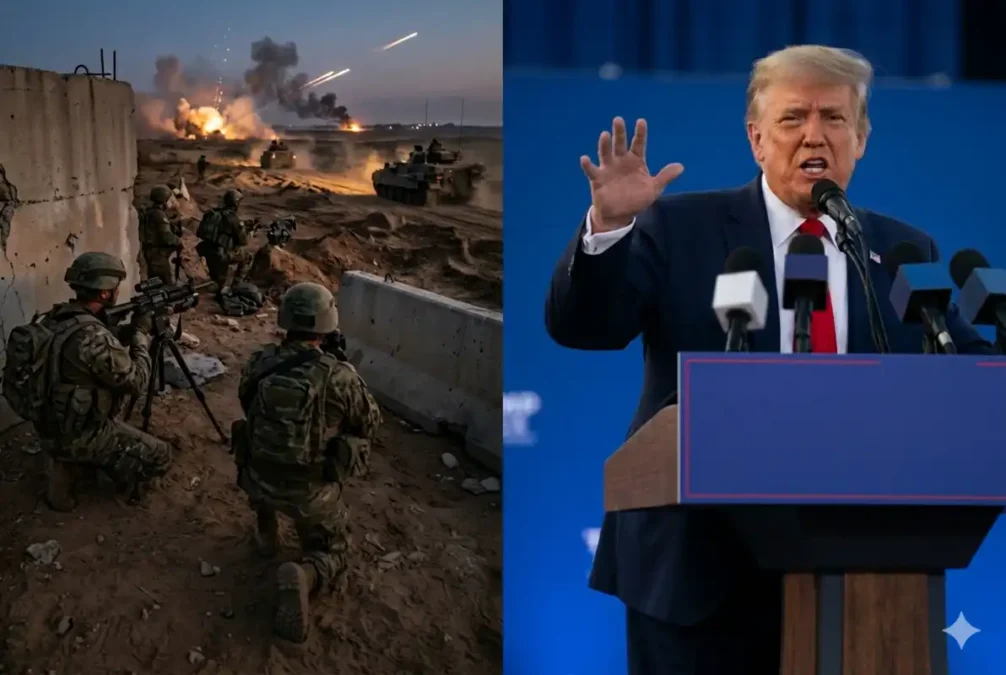
The US-Israel military campaign against Iran continues unabated, and so does US President Donald Trump’s tirade against Iran on X. After issuing his strongest warning yet last Wednesday, April 1, to intensify missile strikes over the coming weeks and then abusing his opponents on social media, Trump has now said that a ceasefire deal is possible.
He had earliser insisted that American forces would achieve all their war objectives “very, very shortly.” However, the latest is that a ceasefire proposal is on the table, but peace remains elusive. While Iran and the US have both received a plan that would result in an immediate ceasefire followed by a broader agreement to end the war, Iran has already rejected Washington’s proposal, insisting on a permanent resolution rather than a temporary halt. Adding another condition to the negotiating table, Trump has stated that free passage of oil through the Strait of Hormuz must be part of any deal. On the ground, the violence continues. The UAE authorities responded to fresh missile and drone threats in Abu Dhabi and Fujairah, with one person injured after shrapnel fell in the capital, as the country engaged 12 ballistic missiles, two cruise missiles, and 19 drones on April 6th alone. Meanwhile, strikes in Tehran have reportedly killed 13 people and caused widespread gas outages, and four were killed in Israel’s Haifa following an Iranian missile strike. With a senior Iranian official firmly stating that Tehran will not accept deadlines or pressure to reach a decision, a resolution appears anything but imminent.
The ongoing conflict continues to shake global energy markets as stocks fell sharply, and oil prices surged, unsettling regional security.
UAE Shields Its Skies: The Numbers Behind the Defense
While the US-Isreal war continues to go through dramatic turns, the UAE has been fighting its own battle in the skies night after night.
According to the latest figures from the UAE Ministry of Defence, on April 6, 2026, the country successfully intercepted 12 ballistic missiles, 2 cruise missiles, and 19 UAVs launched from Iran. Since the onset of the Iranian attacks, the UAE’s multi-layered defense systems have engaged a total of 519 ballistic missiles, 26 cruise missiles, and 2,210 UAVs.
Related Stories

These are not just numbers. Each interception means a live threat stopped before it could hit cities, airports, ports, or homes.
The Human Cost of War
As per reports, so far, two UAE Armed Forces members have been killed on duty amid the ongoing attacks from Iran. A civilian contractor of Moroccan nationality working with the military also lost his life. Nine more civilians from Pakistan, Nepal, Bangladesh, Palestine, and India were killed. A total of 190 people have been injured due to daily interceptions. These people belong to more than 30 nationalities, including Emirati, Egyptian, Filipino, Indian, Sri Lankan, and Swedish.
Related Stories

Across all seven emirates, security and emergency services have responded very quickly to every incident.
Disruption of daily routine in the Emirates
The ongoing war has not only caused disruption in the global scenario; it has also touched everyday life far beyond the battlefield.
The schools and classrooms have gone quiet. All the nurseries, kindergartens, and public and private schools have switched to remote learning until April 17, with the Ministry of Education prioritizing the safety of students and staff.
Related Stories

The skies of Dubai tell the same story: Dubai International Airport is operating on a reduced schedule, with many airlines suspending or cutting back flights following a drone incident near the airport on March 30.
Fuel prices have risen sharply. Super 98 petrol climbed to Dh3.39 per liter, a sharp rise from what people were paying last month. Diesel has surged even more, Dh4.69 per liter from Dh2.72—this is a direct result of the war’s impact on global energy markets.
UAE Calls for Restraint
Even after absorbing relentless waves of aerial attacks, the UAE has kept a calm and measured stance diplomatically. The UAE Ministry of Defence has repeatedly called for an end to military escalation, even as its air defense systems operate 24 hours a day without fail.
The residents of Emirates are urged to stay alert, follow only official sources for emergency updates, and remain indoors during active interceptions. The National Emergency Crisis and Disaster Management Authority (NCEMA) continues to monitor and advise the public during critical times, guiding them to seek shelter.
However, there are no ceasefire talks on the table, and US President Trump is pushing their military front harder; peace still seems like a faraway dream. For a country like the UAE, built on openness, trade, and stability, the hope for diplomacy to win over destruction remains strong.